Why Purpose-Led Branding in India Is Winning Consumer Trust in 2026
Why Purpose-Led Branding in India Is Winning Consumer Trust in 2026 Purpose-led branding in India is winning trust because Indian...
Read More → 
THE BEST MARKETING CONSULTANT IN DELHI
Short-form video has become a major part of social media strategy in 2026, with Instagram Reels, YouTube Shorts, and Facebook Reels putting vertical videos in front of audiences beyond your existing followers. Unlike a traditional post that may mainly reach people who already know your brand, a well-made short video can attract new viewers, build awareness, and introduce your business to potential customers. For brands looking to expand their online reach, short-form video is no longer just a trend—it has become an important part of a practical social media strategy.
For a business, that changes what “social media strategy” even means. Here’s how it works and how to build around it.
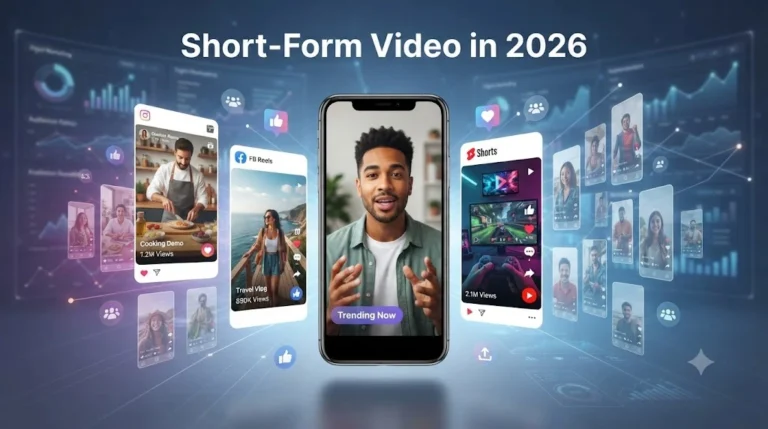
Short-form video means vertical clips, usually somewhere between 15 and 60 seconds, made for a phone held upright. The main formats are Instagram Reels, YouTube Shorts and Facebook Reels.
Platforms favour these formats because they keep people watching. A viewer swipes, gets a new clip in a second, and stays in the app. To keep that loop going, the algorithm shows videos from accounts the viewer doesn’t follow, based on what they watch and finish. So for a small brand, distribution depends far more on the quality of the video than on the size of the audience.
Reach isn’t limited to your followers. Static posts mostly circulate among people who already know you. Video gets tested on small groups of new viewers and then pushed further if they respond well.
It shows what a brochure can’t. If you sell a product, you can show it in use in twelve seconds. If you sell a service, you can show the process, the result, or the mistake people usually make.
It builds familiarity quickly. Someone who has watched five of your short videos already recognises your face, voice and style. That makes a later enquiry much warmer.
It’s cheap to test. A reel shot on a phone costs almost nothing to produce, so you can run many small experiments rather than betting on one big campaign.
Views alone can mislead you. What platforms care about is how much of the video people actually watch. A 20-second reel that most viewers watch to the end will usually beat a 50-second one they abandon halfway.
That’s why video completion rate has become the number to watch. Check it in Instagram Insights or YouTube Studio for each video and look for the point where viewers drop off. If most people leave in the first three seconds, your hook is the problem. If they leave in the middle, the pacing or the value is.
Some practical ways to lift it:
Hook-based storytelling is the habit of opening with the most interesting part of the story instead of building up to it. Viewers decide almost instantly whether to keep watching, so the hook does most of the work.
A few hook styles that work for business content:
After the hook, a simple structure holds most good short videos together: a hook, one useful idea, a quick proof or example, and a single closing line that tells the viewer what to do next. One idea per video is a good rule. When you try to fit three, viewers usually leave.
You don’t need to be everywhere on day one, but it helps to know the difference.
Instagram Reels suit brands where visuals, personality and community matter. They work well for retail, food, fashion, beauty and personal brands, and viewers can move easily from a reel to your profile, stories and DMs.
YouTube Shorts tend to work well for search-driven and educational content, since YouTube is also a search engine. Shorts can also lead viewers to your longer videos.
For most small businesses, a sensible route is to make one video and adapt it for both platforms. Reuse the same footage, and change the captions, hashtags and cover to fit each one. Just avoid uploading a clip with another platform’s watermark visible, since that can hurt its reach.
Rather than chasing every passing trend, focus on the shifts that are structural:
Short-form video works best when it’s planned, not improvised. Decide on three or four content themes, batch-shoot several clips in a single session, and schedule them across the week. Having a plan makes consistency realistic, and that’s where most brands fall short. If you’re building that plan, our guide to creating a content calendar in this same series walks through it step by step.
It also needs to fit inside a wider strategy. Video brings attention, but your profile, website and follow-up have to turn that attention into enquiries or sales. That connection is what a proper social media plan covers, and it’s what we look at in more detail on our social media marketing consultant in Delhi page.
There’s no single ideal length. Most business videos work well between 15 and 45 seconds. A better rule is to make the video exactly as long as the idea needs, then check your completion rate to see whether viewers stay to the end.
It’s the share of viewers who watch a video through to the end (or close to it). Platforms use it as a signal of whether a video is worth showing to more people, so a video with strong completion usually gets pushed further than one with more views but early drop-offs.
A pace you can keep up matters more than a big number. Three to five videos a week is a common target, but one good video a week posted consistently beats a burst of posts followed by a month of silence.
Start where your customers already spend time. Reels suit visual, personality-led and community-driven brands, while Shorts suit educational and search-driven content. If you’re unsure, shoot once and adapt the same footage for both.
No. A recent smartphone, natural light and clear audio are enough. Audio matters more than most people expect, so a cheap clip-on mic is often the best first upgrade.
A good hook puts the most interesting part first: the result, a common mistake, a contrarian claim, or a direct question your ideal customer would ask themselves. Avoid greetings and introductions, and start with the point.
No. B2B companies and service providers use it to explain their process, answer common client questions and build trust before the first conversation. The topics change, but the format works for both.
You can reuse the footage, but adapt the caption, cover image and hashtags for each platform. Also avoid leaving another app’s watermark on the video, since that can reduce its reach.
They can, but only when the rest of your setup supports it. The video earns attention, and your profile, link, website and follow-up have to turn that attention into an enquiry. Give each video one clear next step, such as visiting your profile, sending a DM or booking a call.
It varies with your niche, consistency and content quality, so there’s no reliable timeline. Review your retention and engagement after a few weeks of regular posting, then adjust your hooks and topics based on what the data shows rather than expecting quick wins.
If you’d like help working out which formats, topics and posting rhythm suit your brand, get in touch with Ritwik Sachdeva. It starts with a conversation about your goals, no obligation attached.