Why Purpose-Led Branding in India Is Winning Consumer Trust in 2026
Why Purpose-Led Branding in India Is Winning Consumer Trust in 2026 Purpose-led branding in India is winning trust because Indian...
Read More → 
THE BEST MARKETING CONSULTANT IN DELHI
Short answer: most Delhi sellers should start on marketplaces like Amazon and Flipkart to get orders and cash flow, and then put steadily more effort into their own website once they have a product that repeats. Marketplaces rent you customers. Your own website lets you keep them. The right split depends on your margins, your repeat-purchase rate and how much brand you want to build.
Picture a seller in Delhi doing steady sales on Amazon. Orders come in daily, but the numbers don’t improve. Ad costs creep up and a competitor undercuts the price. Reviews, listings and customers all sit on a platform they don’t control. Then they try launching a Shopify store and get almost no traffic for two months.
Both situations are common, and neither channel is the problem. The problem is treating “marketplace vs own website” as a choice you make once. This guide explains what each channel actually gives you, where the money goes, and how to decide where your time should go.
Amazon, Flipkart, Myntra and Meesho already have the traffic. Someone searching for a product on these platforms is usually ready to buy, so a new seller can get a first sale in days, not months. Logistics, payment handling and customer trust come built in.
You pay for that in several ways:
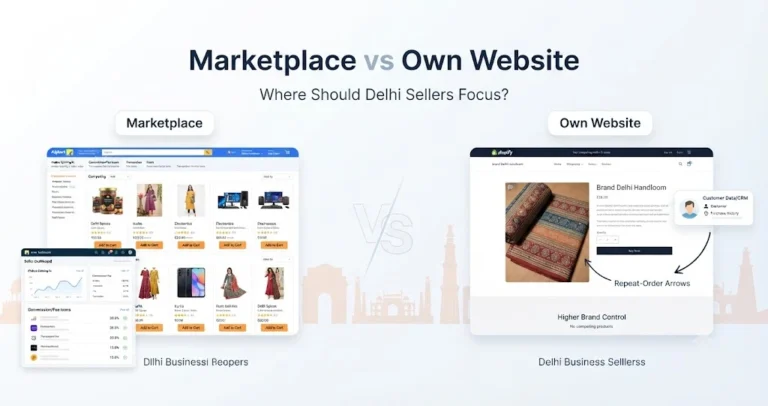
A Shopify or similar store flips the equation. You control the design, the pricing, the offers and the whole buying experience. You also own the customer relationship, which is where D2C brands make their money over time: repeat orders, bundles, subscriptions and referrals.
What you take on:
Gateway fees and subscription costs on your own site are generally predictable. You can see them upfront, unlike marketplace costs that stack up across several line items.
Marketplace (Amazon, Flipkart) | Own website (Shopify etc.) | |
Time to first sale | Fast | Slow, depends on traffic |
Customer data | Platform owns it | You own it |
Brand control | Low | Full |
Cost structure | Commission + fees + ads | Subscription + gateway + marketing |
Repeat-purchase potential | Limited | High |
Effort to start | Moderate | Higher |
Dependence on a third party | High | Low |
If you’re just starting out, or your product is new and untested, lead with marketplaces. You learn what sells, what customers complain about and what price the market accepts, all without spending heavily on traffic first.
If you already have steady marketplace sales, begin building the website in parallel. Use packaging inserts, follow-up messages where the platform allows them, and your social profiles to move buyers toward ordering direct. Don’t expect the website to replace the marketplace in six months.
If your product has high repeat value (skincare, food, consumables, accessories people collect), your own website deserves much more of your attention. Lifetime value is where D2C pays off.
If you sell commodity items with thin margins, a marketplace will probably stay your main channel, since you can’t afford the marketing needed to pull customers to your own site.
If you sell on quick commerce platforms, treat them as a separate channel with different economics. We cover that in our guide to quick commerce for Delhi sellers, which sits alongside this decision.
Most sustainable ecommerce businesses end up selling in more than one place. The marketplace brings discovery and volume. The website brings margin and loyalty. The risk is spreading yourself thin, so multi-channel selling works only if the basics are managed centrally:
This is the kind of day-to-day coordination that ecommerce management services in Delhi are meant to handle, so the owner isn’t juggling five dashboards.
For a new seller, Amazon or Flipkart is usually faster for first sales. Your own website is better for margin, customer data and repeat orders. Most growing sellers end up using both.
Yes, and many sellers do. You need one shared inventory view and a clear pricing approach so the channels don’t conflict or oversell stock.
It can be, because you avoid marketplace commissions and own the repeat purchase. But you pay for traffic yourself, so profit depends on how efficiently you acquire customers.
Work out your margin on each marketplace after the referral fee, closing fee, shipping and ads. If what’s left is thin, your own website or a higher price point may serve you better.
You can start selling on your own site without one. But registering a trademark protects your brand, and marketplace brand registry programmes often require it. Check current requirements with a legal or compliance professional.
It varies with your product, budget and marketing channels. Paid ads can bring orders quickly if your offer converts, while SEO and organic growth take longer.
It depends on your category. Amazon and Flipkart suit most products, Myntra suits fashion and Meesho suits low-price, high-volume items. Check each platform’s category rules and fees before choosing.
Don’t cut the marketplace. Build your own channel alongside it. Use packaging inserts, social media and email or WhatsApp (where the platform’s rules allow) to bring repeat buyers to your website.
Cash-on-delivery orders that get refused (RTO) cost you shipping both ways and block your stock. Many sellers reduce this with order confirmation calls or messages and by offering a small prepaid discount.
When you’re selling on two or more channels and spending more time on dashboards, listings, inventory and ad reports than on the product itself. That is usually when expert help pays for itself.
Choosing between marketplace and own website is easier when someone looks at your actual numbers: margins, return rates, ad spend and repeat customers. If you’d like a straight opinion on where your effort will pay back, Ritwik Sachdeva works with Delhi sellers on exactly this kind of channel decision.
Call or WhatsApp 9289626386, or visit ritwiksachdeva.in and tell us what you currently sell and where.