Why Purpose-Led Branding in India Is Winning Consumer Trust in 2026
Why Purpose-Led Branding in India Is Winning Consumer Trust in 2026 Purpose-led branding in India is winning trust because Indian...
Read More → 
THE BEST MARKETING CONSULTANT IN DELHI
If you’re only going to remember one thing from this piece, remember this: reels drive reach, long-form video drives revenue. The real question isn’t which format wins — it’s which job you’re hiring each one to do. Brands that treat this as an either/or usually end up with a feed full of views that never turn into customers, or a YouTube channel with great watch time and nobody discovering it.
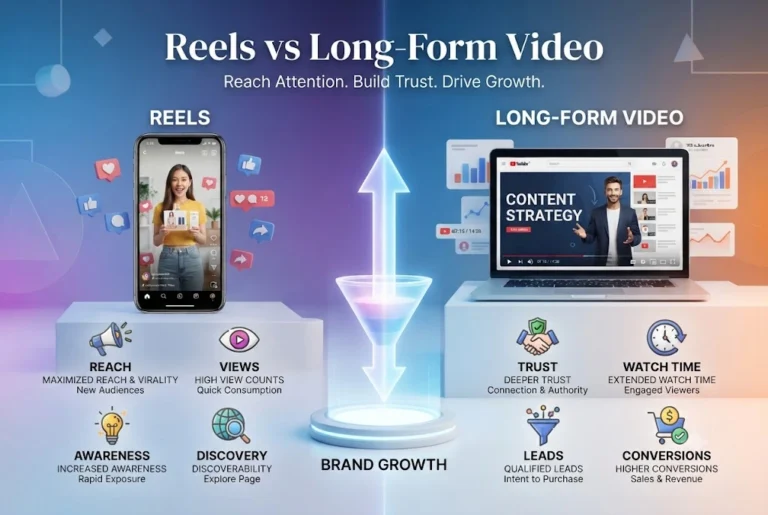
Every platform has trained creators to think in extremes. Instagram and YouTube both push short-form hard because it keeps people scrolling longer, so brands assume “short-form wins” is the whole story. But scroll a little further into the data and a different pattern shows up: reels get you in front of people, long-form gets people to trust you enough to buy.
That distinction matters more than any engagement-rate benchmark you’ll find in a generic listicle, because engagement rate alone doesn’t tell you whether the person watching is a stranger or a future customer.
Reels (and their cousins — TikToks, YouTube Shorts) are built for one thing: distribution beyond your existing followers. The algorithm on all three platforms is currently biased toward pushing short vertical video to non-followers, which is why a brand-new account can occasionally get more reach on one reel than an established account gets on a whole month of posts.
Where reels genuinely earn their place in a content strategy:
Where reels fall short: they rarely build depth. A viewer can watch ten reels from your brand and still not understand what you actually sell, why you’re different, or why they should trust you with their money.
Long-form — think 5 to 20 minute YouTube videos, in-depth product walkthroughs, or detailed explainer content — plays a completely different role. It doesn’t win on reach. It wins on conversion and retention.
A few reasons long-form consistently outperforms short-form on the metrics that actually matter for growth:
This repurposing angle is honestly the most underused part of most brands’ content strategy. Instead of treating short and long-form as separate production pipelines, the smarter move is to film long-form first and mine it for weeks of short-form content afterward.
It depends on where your brand currently sits, not on some universal “better” format.
If you’re under 10,000 followers or your brand is new, weight your effort toward reels. You need reach before you need depth — nobody can be converted by long-form content they never see in the first place.
If you already have an engaged audience but conversions feel stuck, shift weight toward long-form. Your problem isn’t visibility anymore; it’s depth. People know you exist but don’t know enough to buy.
If you’re running paid campaigns alongside organic, long-form (or mid-form, 60–90 second) content tends to perform better as an ad creative because it gives the algorithm more signal to optimize against, even if the full video is rarely watched end-to-end.
A realistic split for most growing brands looks less like “reels vs long-form” and more like a pipeline: shoot one solid long-form piece a week or two, then cut 5–8 reels from it. You get reach and depth from the same shoot, instead of running two disconnected content calendars.
Chasing reel virality with no follow-through. A reel that hits 200K views but links nowhere, explains nothing, and isn’t followed up by anything deeper is a dead end. Reach without a next step is just noise.
Publishing long-form with zero short-form support. A brand that only posts 15-minute YouTube videos and expects organic discovery is fighting an uphill battle — almost nobody stumbles onto a new channel’s long video cold. Short-form is how people find the long-form in the first place.
Measuring both formats against the same KPI. If you’re judging a reel by watch-time-per-viewer or a long-form video by raw view count, you’re using the wrong lens for the format. Reach metrics belong to short-form; retention and conversion metrics belong to long-form.
Ignoring platform-specific algorithm behavior. Instagram, YouTube, and TikTok don’t distribute content the same way — what works as a growth lever on one can underperform on another. Treating “post everywhere identically” as a strategy usually means none of the content is actually optimized for the platform it’s on.
Getting the editing and pacing right for each format is where a lot of this either works or falls flat — a reel cut like a mini-documentary underperforms, just like a long-form video edited with jump-cuts every two seconds loses the depth that makes it worth watching. This is exactly the kind of platform-specific editing our Video Editing Services are built around — shaping the same raw footage differently depending on whether it’s headed for a 15-second reel or a 10-minute upload.
Reels typically post higher engagement rates on paper because they’re shown to a much larger, mostly cold audience — more views naturally mean more raw likes and comments. But engagement rate isn’t the same as engagement quality. Long-form video usually pulls a smaller but far more invested audience, which tends to translate into stronger comment quality, more direct messages, and more actual sales conversations.
Yes — this is the most efficient way to run a content strategy. Shoot the long-form piece with reels in mind (clear individual talking points, natural pauses that work as cut points), then pull 5–8 short clips from it during editing. This is a core part of content repurposing, and it’s far cheaper than producing short and long-form content separately.
Each platform weighs different signals. Short-form leans on completion rate and rewatches within the first few seconds. Long-form leans more on total watch time and session continuation. Neither algorithm cares about follower count as much as creators assume — a low-follower account with high completion rate can still get significant reach.
It can be, but sequencing matters. If nobody knows your brand yet, long-form content has almost no one to be shown to. Building initial reach through short-form first, then layering in long-form once you have a base audience, tends to work better than starting with long-form alone.
The line has moved. A few years ago, anything over 60 seconds was long-form. Today, with Reels and Shorts stretching up to 90 seconds and even 3 minutes on some platforms, most people use “long-form” to mean content in the 5–20 minute range — usually YouTube uploads, in-depth walkthroughs, or podcast-style videos. Anything under 90 seconds is still functionally short-form, regardless of the exact platform limit.
Not without adjusting it. Each platform’s algorithm reads different signals, so a video edited for one often underperforms on another — captions, pacing, and even the first-second hook usually need to change. Cross-posting the exact same file everywhere is fine as a starting point, but tailoring the edit per platform is what actually moves reach.
Generally yes, especially on YouTube, which is the second-largest search engine and indexes video content directly against search queries. A well-titled 10-minute video answering a specific question can rank in search results for months, while a reel’s discoverability window is usually a few days. Reels support brand awareness; long-form supports being found.
There’s no universal number, but a workable starting cadence for most small-to-mid brands is 3–5 reels a week paired with 1 long-form video every one to two weeks. The reels keep the algorithm regularly serving your content to new people; the long-form piece gives that audience somewhere deeper to land once they’re curious.
It happens, but it’s the exception, not the rule. Reels are better at creating awareness and curiosity than closing a decision — most people need a second or third touchpoint (a profile visit, a website check, a longer video) before they buy. Treating a reel as the entire conversion path usually leads to disappointing sales numbers despite decent view counts.
This usually points to a retention problem rather than a reach problem — people are clicking in but dropping off before reaching the part worth reacting to. Check your average view duration: if most viewers leave in the first 20–30% of the video, the opening isn’t delivering on what the title or thumbnail promised, which is worth fixing before investing in more long-form content.
Reels and long-form video aren’t competitors — they’re stages of the same funnel. Reels get attention; long-form earns trust. Brands that grow consistently usually aren’t the ones that picked a side, they’re the ones that built a repeatable system connecting the two.
If you’re trying to figure out how this split should look for your specific brand — how much to invest in each format, and how to keep both consistent without burning out your team — that’s exactly the kind of planning our Social Media Marketing Agency work covers, alongside the editing itself. You can reach out directly at 9289626386 or through ritwiksachdeva.in to talk through what your current content mix looks like and where the gaps are.