Why Purpose-Led Branding in India Is Winning Consumer Trust in 2026
Why Purpose-Led Branding in India Is Winning Consumer Trust in 2026 Purpose-led branding in India is winning trust because Indian...
Read More → 
THE BEST MARKETING CONSULTANT IN DELHI
A shopper can’t touch, smell, or try on anything before they buy online. The photo is the entire pitch — and most sellers still treat it as an afterthought. That gap is exactly why professional product photography moves conversion rates more than almost any other single change on a product page.
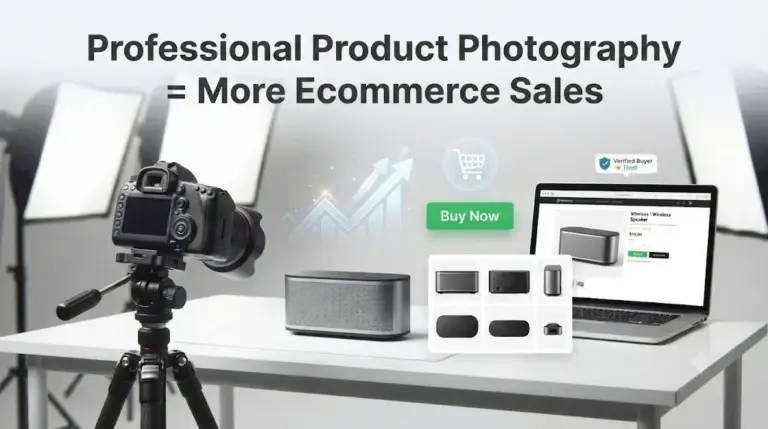
Think about the last time you scrolled past a listing with a blurry, poorly lit photo shot on a phone against a cluttered background. You probably didn’t stop to read the description — you just moved on. That’s the decision happening on your own product pages, dozens of times a day, without you seeing it.
Bad photography doesn’t just look unpolished. It actively signals risk to the buyer: if the seller didn’t bother to show the product properly, what else did they cut corners on? Packaging quality, sizing accuracy, whether the item even matches the picture — all of that doubt gets triggered by a weak image, before the buyer reads a single line of copy.
Clean, consistent lighting, accurate colour reproduction, and multiple angles do something a paragraph of text can’t — they answer the buyer’s unspoken question of “is this real, and is it worth my money?” in under two seconds. Trust at this stage isn’t emotional, it’s practical: the buyer is checking texture, finish, stitching, scale, and proportion, and a proper shoot shows all of that clearly instead of leaving it to guesswork.
When a listing has sharp, well-lit images from multiple angles — including close-ups of texture or detail — buyers spend less time hesitating and more time deciding. Fewer unanswered visual questions means fewer people bouncing to check a competitor’s listing instead. This is why product photography sits so close to conversion rate in ecommerce: it removes friction at the exact moment someone is deciding whether to click “buy.”
A photo that shows true colour and true scale sets accurate expectations. When the product that arrives matches what the buyer saw, returns for “not as pictured” drop. That’s a real cost saving that compounds over hundreds of orders, not just a vanity metric.
Consistency matters as much as quality. When every product on your store follows the same lighting style, background, and angle set, the catalogue reads as one cohesive brand instead of a pile of mismatched listings. That’s what proper visual merchandising is — not just “nice photos” but a system that makes your entire storefront look like it belongs to a serious, established business.
Even sellers who invest in photography often lose the benefit through a few repeat mistakes:
Indirectly, yes. These platforms weigh click-through rate and conversion rate heavily in how they rank listings. A stronger photo set improves both, which in turn improves visibility — even though the image itself isn’t a direct ranking input.
Often yes. Marketplaces enforce strict background and framing rules (usually plain white, product-only), while your own website or Instagram can use lifestyle and styled shots that tell more of a story. A proper shoot plans for both from the start instead of reshooting later.
There’s no fixed number, but buyers generally expect enough angles and detail shots to answer every visual question they’d have if they were holding the product in a store — usually somewhere between five and eight images for anything beyond the simplest item.
Some issues — poor colour accuracy, awkward angles — can be partly corrected in editing. But problems like weak lighting or low resolution at the source usually can’t be fully fixed after the fact, which is why getting the shoot right the first time matters more than heavy post-processing.
It matters at every price point, arguably more so for low-priced items sold in volume. A small lift in conversion rate on a product selling hundreds of units a month adds up faster than the same lift on a slow-moving expensive item. The shoot cost is usually recovered quickly once the better images are live.
White-background shots are the clean, product-only images marketplaces require for the main listing photo. Lifestyle shots show the product in use or in context — on a model, styled on a table, in a room setting — and work better for your own website, ads, and social pages where storytelling helps the sale. Most sellers benefit from having both rather than relying on just one type.
Yes, though it works alongside other factors like pricing and shipping cost. Clear, detailed images reduce the hesitation that makes a buyer leave the page to “compare” elsewhere or think it over. They won’t fix every abandonment reason, but they remove one of the more common visual ones.
Whenever packaging, product design, or variants change — reusing old photos of a redesigned product is one of the fastest ways to trigger returns and complaints. Beyond that, a lot of sellers also refresh shoots every year or two simply to keep the catalogue looking current rather than dated.
A single shoot session can typically cover a full catalogue if the products are planned and grouped in advance — similar categories shot together with the same lighting and background setup keep both cost and turnaround efficient, while still giving each product its own set of angles.
Video is increasingly useful, especially for products where movement, fit, or scale is hard to judge from a still image — clothing, gadgets, or anything with moving parts. That said, photos remain the primary trust signal on almost every marketplace listing, so they shouldn’t be deprioritised in favour of video.
If your listings are losing sales to weak images, that’s a fixable problem — not a pricing problem or a traffic problem. Ritwik Sachdeva runs professional product shoot services in Delhi built specifically for ecommerce sellers who need marketplace-ready, conversion-focused images across their full catalogue, tied into a complete Product Shoot Services offering.
Reach out at 9289626386 or visit ritwiksachdeva.in to get your next shoot planned around what your listings actually need.