Why Purpose-Led Branding in India Is Winning Consumer Trust in 2026
Why Purpose-Led Branding in India Is Winning Consumer Trust in 2026 Purpose-led branding in India is winning trust because Indian...
Read More → 
THE BEST MARKETING CONSULTANT IN DELHI
Performance marketing is a form of digital advertising where you pay only when a specific action happens — a click, a lead, a sale — instead of paying upfront for space or airtime regardless of the outcome. That single shift, from paying for exposure to paying for results, is what separates it from traditional advertising and why more businesses are working with a performance marketing consultant in Delhi to move their budgets away from guesswork.
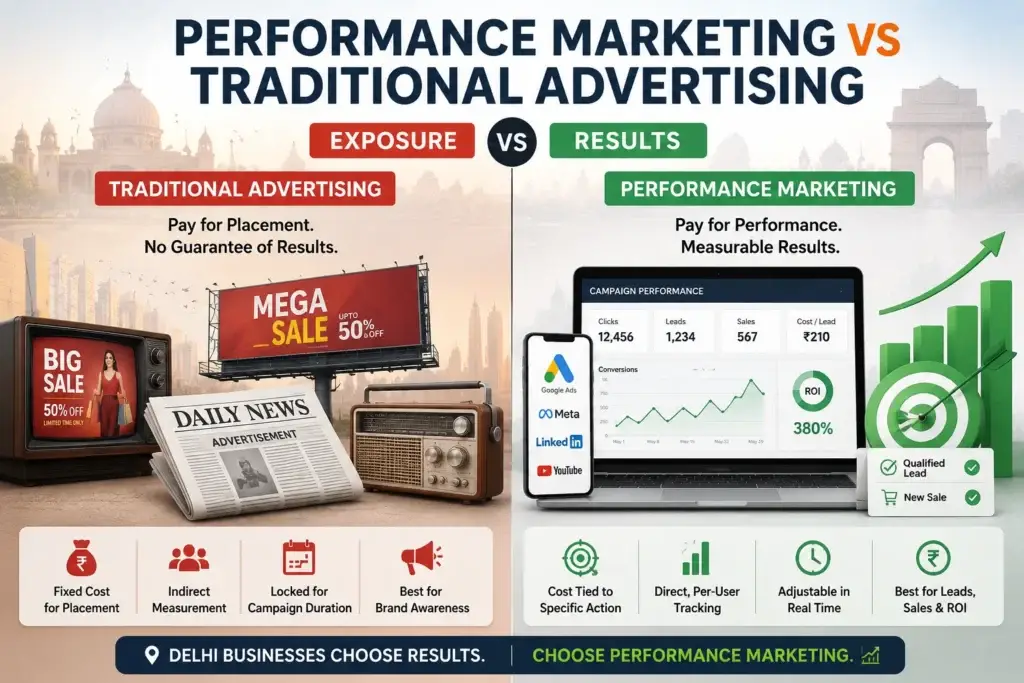
Traditional advertising — TV spots, print ads, hoardings, radio slots — sells you visibility. You pay a fixed amount for a fixed placement, and the ad runs whether or not it actually moves anyone to act. A newspaper ad costs the same on a day it generates ten calls as it does on a day it generates none. There’s no direct line between the spend and the result; you’re trusting reach and repetition to eventually convert.
Performance marketing flips that. Every rupee is tied to a measurable action: cost-per-click, cost-per-lead, cost-per-acquisition. If the campaign underperforms, you’re not stuck paying for empty impressions — you adjust the targeting, the creative, or the bid, often within hours rather than waiting for the next print cycle to fix anything.
In traditional media, measurement is mostly indirect — brand recall surveys, footfall estimates, sales lift assumed to be connected to a campaign that ran weeks earlier. In performance marketing, every action is tracked at the individual level. You know which ad, which keyword, which audience segment, and which device led to a conversion. That data doesn’t just tell you what happened — it tells you what to do next.
This is where data driven campaigns actually earn the phrase. A performance campaign generates a live feed of numbers: click-through rate, conversion rate, cost per lead, return on ad spend. A consultant reading these numbers weekly (sometimes daily) can reallocate budget away from what’s not converting and into what is — something a billboard contract simply doesn’t allow mid-flight.
The pay per action model is the financial backbone of performance marketing. Instead of a flat media buy, you set a target cost for the action that matters to your business — say, ₹300 per qualified lead — and the platform (Google, Meta, or a programmatic network) only charges you when that action is delivered. This changes the risk profile entirely. Traditional advertising asks you to bet on an outcome. Performance marketing asks you to define the outcome first and pay for it directly.
That said, “pay per action” isn’t magic — it still needs the right tracking setup (pixels, conversion APIs, UTM structures) to actually attribute the action correctly. A campaign without clean tracking will report numbers, just not trustworthy ones.
Traditional Advertising | Performance Marketing | |
Payment basis | Fixed cost for placement/airtime | Cost tied to a specific action |
Measurement | Indirect (recall, estimated reach) | Direct, per-user tracking |
Flexibility | Locked in for the campaign duration | Adjustable in real time |
Best for | Broad brand awareness | Leads, sales, app installs, sign-ups |
Feedback loop | Weeks to months | Hours to days |
Neither approach is universally “better” — a large FMCG brand launching nationally still needs mass-reach advertising to build recognition. But for a business that needs to justify every marketing rupee against actual leads or sales, roi driven marketing through performance channels gives a much tighter feedback loop than a print or TV buy ever will.
The mistake many businesses make is running performance marketing with a traditional-advertising mindset — setting a campaign live and checking back only at month-end. Performance marketing only delivers on its promise of measurable ROI when someone is actively reading the data and making changes: pausing underperforming ad sets, testing new creative angles, refining audience targeting based on what the numbers actually show. Without that ongoing attention, you’re just running a more trackable version of a billboard.
This is usually the point where working with a dedicated consultant makes a practical difference — someone whose job is to sit inside the account, watch the numbers change, and make the calls a business owner running a store or a service doesn’t have the bandwidth to make daily.
No — one of its advantages is that it works at almost any budget, since you’re paying per action rather than for a fixed placement. A small business can run a tightly targeted campaign with a modest daily spend and still get measurable leads.
Not entirely. Performance marketing is built to drive immediate, trackable actions like leads or sales. Brand-building advertising works on a longer timeline and different metrics. Most businesses eventually need both, just in different proportions depending on their stage.
Early data — clicks, initial leads — usually starts appearing within days. But drawing reliable conclusions about what’s actually working typically takes a few weeks of data, since single-day numbers can be misleading.
Google Ads (Search, Shopping, Performance Max), Meta Ads, LinkedIn Ads, and programmatic display networks are the most common, each suited to different kinds of actions and audiences.
PPC is one type of performance marketing, not the whole category. Performance marketing also includes pay-per-lead, pay-per-install, and pay-per-sale models — PPC just happens to be the most common one people encounter through Google Search ads.
It usually starts with a target cost per action — what you’re willing to pay for a lead or sale — and works backward from there based on your margins. This is different from traditional advertising, where budget is often decided by the size of the placement (a full-page ad vs. a quarter-page one) rather than the outcome you need.
Yes, and for many established brands this combination works better than either alone. Traditional advertising builds recognition over time, while performance marketing captures the demand that recognition creates. A business running both usually sees performance campaigns convert more efficiently because people already recognise the name.
Click-through rate and impressions matter less than cost per lead, conversion rate, and return on ad spend. It’s easy to get distracted by vanity metrics like reach or clicks when the number that actually affects the business is how much each real lead or sale costs.
It works well for local businesses too, especially service-based ones, since campaigns can be geo-targeted down to specific pin codes or a radius around a shop or office. A local business often gets a lower cost per lead than a national e-commerce brand simply because the competition for that specific area is narrower.
A TV or print campaign is usually judged on reach and frequency — how many people saw it, how many times. A performance campaign is judged on what people did after seeing it: did they click, call, fill a form, or buy. That’s a fundamentally different definition of “success.”
If you’re trying to figure out whether your current advertising spend is actually earning its keep, or you’re ready to move a chunk of budget from traditional placements into something trackable, that’s exactly the conversation a performance marketing consultant should be having with you before any campaign goes live.
Ritwik Sachdeva works with Delhi-based businesses on exactly this shift — building performance campaigns around real numbers instead of estimated reach. You can reach out directly at 9289626386 or check out the full range of services at ritwiksachdeva.in to see what a data-driven approach could look like for your business.
For a closer look at the full scope of services on offer, see the Performance Marketing Consultant & Agency page.