Why Purpose-Led Branding in India Is Winning Consumer Trust in 2026
Why Purpose-Led Branding in India Is Winning Consumer Trust in 2026 Purpose-led branding in India is winning trust because Indian...
Read More → 
THE BEST MARKETING CONSULTANT IN DELHI
DPDP Act is changing how performance marketers in India collect, process, and use personal data for advertising. Marketers can no longer assume that data collected from users can automatically be used for retargeting or audience targeting. Clear and informed consent is becoming essential for activities such as retargeting pixels, lookalike audiences, and CRM-based ad lists. For campaigns targeting Indian users, maintaining a clear and verifiable consent record is now an important part of responsible performance marketing.
If you’re running Meta, Google, or programmatic campaigns for an Indian audience, this isn’t a distant compliance issue for the legal team to handle later. It touches your pixel setup, your cookie banners, your CRM uploads, and how you build audiences for the next campaign you launch.
Performance marketing runs on data — browsing behavior, purchase history, device IDs, email lists uploaded for custom audiences. The DPDP Act classifies almost all of this as personal data the moment it can identify or relate to a specific person. That includes:
Before the Act, most of this ran on implied consent — a small cookie notice, rarely read, rarely refused. Now, consent has to be specific to the purpose, freely given, and withdrawable at any time. A visitor who agreed to receive order updates hasn’t automatically agreed to be retargeted with ads six months later. That distinction is exactly where most current tracking setups fall short.
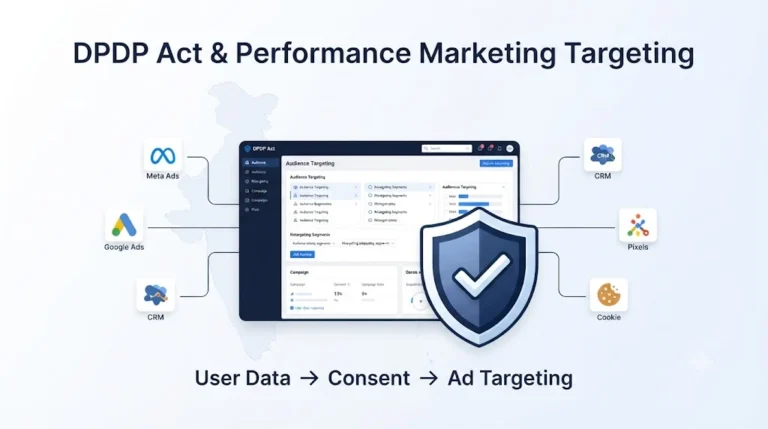
Consent-based targeting means the audience you’re serving ads to has agreed — specifically — to have their data used for advertising, not just for the website to function. Practically, this affects three things marketers touch every day:
Cookie consent has to be granular. A single “Accept All” button that quietly enables ad tracking alongside essential cookies won’t hold up. Visitors need the option to accept analytics or marketing cookies separately from functional ones, and your ad pixels should only fire after that specific consent is given — not before.
Custom Audience uploads need a consent record. If you’re uploading a customer list to Meta or Google for a lookalike audience, you need to be able to show that each contact agreed their data could be used for advertising purposes. A list built purely from checkout or signup data, without an explicit ad-consent checkbox at collection, is now a risk, not an asset.
Data retention needs a purpose and a limit. Holding onto visitor or customer data indefinitely “in case it’s useful later” no longer fits the law’s intent. Retention periods should map to why the data was collected in the first place.
The upside here — and it is a real upside, not just a compliance silver lining — is that first-party data marketing was already where performance marketing was heading, DPDP Act or not. Third-party cookies are disappearing across browsers regardless of Indian law. What the Act does is force the timeline forward.
First-party data — collected directly from your own audience, with clear consent, for a stated purpose — becomes the foundation instead of the fallback. That looks like:
Brands that already run clean first-party data collection will feel almost no disruption from the DPDP Act. Brands still leaning on broad, unconsented third-party targeting will see their audience sizes shrink as platforms and advertisers tighten enforcement.
For campaigns running today, compliance isn’t a redesign of your entire funnel — it’s a few specific fixes:
None of this requires slowing campaigns to a halt. It requires knowing exactly where consent lives in your funnel and closing the gaps quietly, one at a time.
There’s a common assumption that privacy-first advertising means weaker targeting and lower returns. In practice, the opposite tends to hold once the transition settles. Audiences built on genuine, specific consent convert better — the people in them actually expect to be marketed to. The noise of broad, low-intent targeting drops out, and what’s left is a smaller but more responsive list.
The brands that adapt early get two advantages: cleaner data platforms can actually optimize against, and a head start before enforcement tightens further and competitors scramble to catch up.
Yes. The Act applies based on where the personal data belongs to — Indian users — not where the advertiser or agency is based.
Only if that list was collected with consent covering advertising use. If it wasn’t, the safer move is to re-permission the list through a fresh opt-in rather than continuing to use it as-is.
Scale doesn’t exempt anyone. What changes is the practical risk level — but the consent requirements apply the same way regardless of budget size.
Not necessarily. Consented, first-party audiences often show stronger engagement because the people in them opted in with intent, rather than being swept up passively through broad tracking.
A cookie banner typically covers whether the site can function with tracking enabled at all. Advertising consent has to be specific to that purpose — a user agreeing to analytics cookies hasn’t automatically agreed to be retargeted with ads, so the two need to be captured separately.
Both. Withdrawal has to actually stop targeting going forward, which means removing them from existing custom audiences and lookalikes, not just excluding them from future list uploads.
Yes. Any personal data — a phone number included — used for marketing outreach needs the same specific, purpose-linked consent, whether it’s flowing into an ad platform or a WhatsApp broadcast list.
The Act doesn’t set a fixed universal number — it ties retention to purpose. The data should be kept only as long as the stated reason for collecting it remains valid, which usually means defining and documenting your own retention window rather than holding data indefinitely.
Both parties carry responsibility, but as the business collecting the data from your customers, the primary obligation sits with you. Your agency should be operating under clear data-handling terms that reflect that.
Often yes, in the short term — broad, unconsented reach naturally narrows. Most brands see this stabilize as first-party lists grow and consented audiences prove more responsive per click than the larger, looser ones they replace.
If your campaigns are still running on old consent setups — or you’re not fully sure what your pixels and audience lists are actually built on — that’s exactly the kind of gap worth checking before it becomes a bigger one. I work with Delhi-based and pan-India ecommerce brands on exactly this: cleaning up targeting compliance without losing campaign performance in the process. You can reach out at 9289626386 or through ritwiksachdeva.in to walk through where your current setup stands.