Why Purpose-Led Branding in India Is Winning Consumer Trust in 2026
Why Purpose-Led Branding in India Is Winning Consumer Trust in 2026 Purpose-led branding in India is winning trust because Indian...
Read More → 
THE BEST MARKETING CONSULTANT IN DELHI
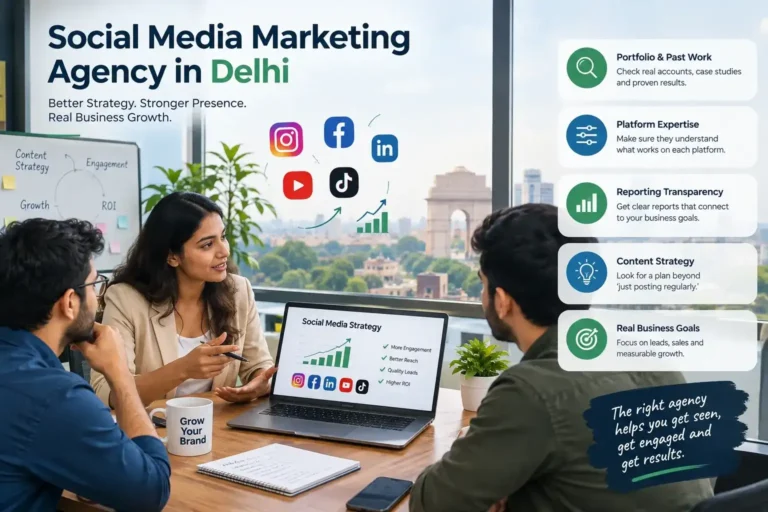
If you’re comparing a social media marketing agency in Delhi, the decision usually comes down to four things: what they’ve actually built before, whether they know the platforms you need (not just Instagram), how honestly they report numbers, and whether they can explain a content strategy beyond “we’ll post consistently.” Get those four right and most other concerns sort themselves out.
Delhi has no shortage of agencies pitching social media packages — from five-person startups working out of a co-working space in Nehru Place to larger setups with dozens of “content creators” on the payroll. The pitch decks all look similar. What separates a good hire from a wasted retainer is what happens after the contract is signed, and that’s exactly what most business owners forget to check for before signing.
Every agency will show you a polished slide of logos and follower counts. That’s not a portfolio review — that’s a highlight reel. A real portfolio review means asking to see:
Ask them to walk you through one campaign they’d call a failure and what they changed because of it. Agencies that can only talk about wins are usually hiding something. The ones worth working with can point to a specific low-performing post or campaign, explain why it underperformed, and show what they did differently the next month.
If an agency is cagey about showing you unedited work — logins to view analytics, not just a PDF report — that’s worth noting before you sign anything.
“We handle Instagram, Facebook, LinkedIn, and YouTube” is a checklist, not a skill set. Platform expertise means understanding what actually works on each one, which changes constantly:
A good sign: the agency asks which platform your actual customers are on before pitching you a package that covers all of them equally. Spreading a small budget across five platforms usually means doing all five badly.
This is where most agency relationships quietly fall apart. Vague monthly PDFs with vanity metrics — reach, impressions, “engagement” bundled together — tell you almost nothing about whether the spend is working.
Before signing, ask exactly what a report will contain:
Reporting transparency isn’t about drowning you in numbers — it’s about whether the numbers connect to something you actually care about. If an agency can’t explain, in one sentence, how a metric they track ties back to revenue or inquiries, that metric is filler.
Posting frequency isn’t a strategy. A real content strategy for a Delhi business should account for:
Ask an agency to sketch a rough content calendar for your business on the spot, even a basic one. You’ll learn more from how they think through that exercise than from any case study they show you.
A few patterns tend to predict a bad working relationship down the line:
Once you’ve shortlisted two or three agencies, the decision usually gets easier if you run a short paid trial — even four to six weeks — before committing to a long-term retainer. Pay attention to how they communicate during that trial, not just the output. Do they flag problems early? Do they ask questions about your business, or just execute a generic playbook?
If you’re weighing this decision as part of a bigger conversation about hiring a social media marketing agency, the same checks above — portfolio, platform fit, reporting honesty, and strategy depth — apply whether you’re a small D2C brand in Delhi or scaling across multiple cities.
Pricing varies widely based on platform count, content volume, and whether paid ad management is included — agencies with junior, unsupervised teams often price lower but deliver less oversight. Get a clear scope of deliverables before comparing numbers across agencies.
For businesses with strong local or hyperlocal targeting needs (a physical store, a Delhi-specific audience, or event-driven content), a locally based team that understands the city’s context tends to execute faster. For purely digital/D2C brands, location matters less than platform expertise.
Give it a defined trial period — four to six weeks is reasonable — rather than judging results in the first two weeks. Look at whether reporting stays honest and whether strategy adapts based on what the data shows, not just whether follower counts went up.
A social media-focused agency specializes in content, community, and platform-specific strategy. A full digital marketing agency usually bundles this with SEO, paid search, and broader digital strategy — useful if you need everything under one roof, but sometimes at the cost of deeper social media specialization.
Ask to see unedited analytics from a past account, not just a case-study PDF; ask who specifically will manage your account day-to-day; ask how they’d handle a month where results dip; and ask what a typical reporting cycle looks like before you sign anything.
Not necessarily. Some agencies handle organic content and paid boosting together, which can keep strategy consistent — but only if they’re genuinely skilled at both. If an agency is clearly stronger at one, it’s worth asking directly rather than assuming both are handled equally well.
Usually two, sometimes three — whichever platforms your actual customers use. Spreading a limited budget across five platforms tends to produce mediocre content everywhere instead of strong content somewhere. A good agency will push back on your platform list rather than agreeing to manage all of them.
It should reflect your actual sales cycle — festive spikes, seasonal demand, or local events relevant to your category — rather than a generic template repeated every month. Ask an agency to sketch a rough one during your first conversation to see how they think.
Be cautious of any agency that promises a specific sales number upfront, since social media influences awareness and consideration more directly than it guarantees conversions. A credible agency will talk about the metrics that lead toward sales — inquiries, DMs, website clicks — rather than promising the sale itself.
Start with a short trial, ideally four to six weeks, before committing to a longer retainer. This gives you a real look at communication, reporting honesty, and strategy adjustments without locking in a year-long commitment based only on a pitch.
Looking for a social media marketing partner in Delhi who’s upfront about numbers and builds a strategy around your actual goals? Get in touch with Ritwik Sachdeva — visit ritwiksachdeva.in or call 9289626386 to talk through what your brand actually needs before committing to anything.