Why Purpose-Led Branding in India Is Winning Consumer Trust in 2026
Why Purpose-Led Branding in India Is Winning Consumer Trust in 2026 Purpose-led branding in India is winning trust because Indian...
Read More → 
THE BEST MARKETING CONSULTANT IN DELHI
AI in Performance Marketing is changing how advertisers manage campaigns in 2026. Two years ago, a media buyer could spend half the week manually adjusting bids across different campaigns. Today, much of that time is spent reviewing decisions made by AI-powered algorithms and stepping in when those decisions don’t match the campaign’s goals. This shift means less manual bid management and more focus on monitoring, strategy, and human oversight of systems that can analyze data and react faster than any marketer.
If you’re running ads in Delhi or anywhere else right now, this isn’t a future trend you can wait out. Google, Meta, and most major ad platforms have already rebuilt their core bidding and targeting infrastructure around machine learning. The question isn’t whether to use AI — it’s whether you understand what it’s doing well enough to catch its mistakes.
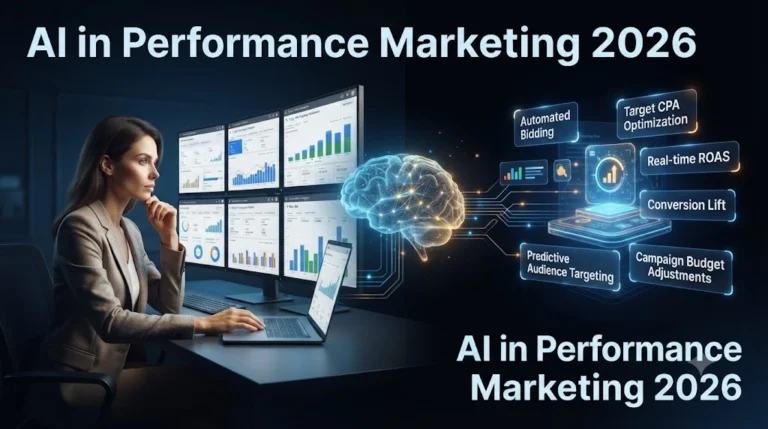
Machine learning bidding is the clearest example. Instead of a human setting a bid for every keyword or placement, the algorithm predicts the likelihood of a conversion for each individual auction — factoring in device, time of day, location, past behavior, and dozens of other signals — and adjusts the bid in real time. This happens thousands of times a second, which is simply not something a person can replicate manually.
Automated campaign optimization goes further than bidding. Modern platforms now test ad creative combinations, shift budget between ad groups based on performance, and pause underperforming variations without a human clicking anything. Ad ad optimization tools flag anomalies — a sudden CPA spike, an audience segment quietly outperforming the rest — often before a marketer would have noticed scrolling through a dashboard.
Predictive analytics marketing sits underneath most of this. Instead of only reporting what already happened, these systems forecast what’s likely to happen next: which audience segments are about to fatigue, which campaigns are trending toward a budget cliff, which creative angle is losing steam. That forward-looking layer is the real difference between 2020-era reporting and 2026-era campaign management.
Smart bidding strategies work best when they have enough conversion data to learn from and clear goals to optimize toward. A campaign with steady conversion volume and a well-defined target CPA or ROAS will usually outperform manual bidding within a few weeks, simply because the algorithm is reacting to patterns no human is tracking in real time.
Where this breaks down is low-volume accounts. If a campaign gets a handful of conversions a month, the algorithm doesn’t have enough signal to learn from, and smart bidding can behave erratically — chasing noise instead of a real pattern. This is a common mistake we see in Delhi-based ecommerce and service accounts that switch to automated bidding too early, before the account has built up conversion history. The fix isn’t avoiding automation altogether; it’s sequencing it correctly, starting with manual or semi-automated bidding until there’s enough data for the machine to actually learn something useful.
AI-driven optimization is genuinely good at finding patterns across huge datasets faster than a person can. What it’s not good at is understanding business context it was never told — a seasonal push, a stock shortage, a brand reputation issue that shouldn’t show up in a search ad right now. This is exactly the tension at the center of the Performance Max vs. manual debate, which is worth its own detailed comparison if you’re deciding how much control to hand over.
The practical answer for most Delhi businesses in 2026 is a hybrid approach: let the algorithm handle bid-level and placement-level decisions where it has enough data, but keep human judgment on strategy, budget allocation across campaigns, and creative direction. Full automation without oversight tends to drift toward whatever metric the algorithm was optimized for — which isn’t always the metric that actually matters to the business.
A few patterns show up repeatedly when reviewing accounts that lean too heavily on automation without oversight:
Performance marketing in 2026 isn’t about choosing between AI and human strategy — it’s about knowing exactly where each one is doing the actual work. The accounts that perform well are the ones where someone is reading what the algorithm is doing, not just accepting the output because it’s automated.
That’s the core of what a performance marketing consultant actually does differently from a self-serve ad account: reading the account behind the automation, catching what the algorithm is optimizing for versus what the business actually needs, and adjusting the account structure so the AI has good data to learn from in the first place.
Not automatically. It makes campaigns more efficient at optimizing toward whatever goal they’re given — but if that goal or the underlying account structure is wrong, AI will scale the mistake faster than a human would have, not fix it.
Generally not immediately. Accounts with low conversion volume don’t give the algorithm enough data to learn from. It usually makes sense to build conversion history first, then transition into automated bidding once there’s a reliable pattern to optimize.
It automates a large part of targeting and placement decisions, but budget strategy, asset quality, and audience signals still need human input to work well — this is covered in more depth in the Performance Max vs. manual comparison.
It replaces a lot of manual, repetitive optimization work. It doesn’t replace the judgment needed to set the right goals, structure the account correctly, and catch cases where the algorithm is optimizing for the wrong thing.
This varies by platform and campaign type, but the general principle is consistency over volume alone — a steady trickle of conversions over several weeks teaches the algorithm more than a random burst. An account with sparse or erratic conversions will usually see the algorithm chase noise rather than a real pattern.
This usually traces back to a signal change the algorithm wasn’t told about — a landing page swap, a pricing change, a new offer, or a shift in what counts as a “conversion” in tracking. The algorithm keeps optimizing toward the old pattern until it has enough new data to relearn, which is why monitoring after any account change matters.
Yes, and this is common practice — running automated bidding on campaigns with enough conversion history while keeping manual control on newer or lower-volume campaigns until they build up data. The two don’t need to be an all-or-nothing decision across an entire account.
No — it means the platform can spot patterns in the data it has access to faster than a person scanning a dashboard. It has no awareness of context outside that data: a stock shortage, a reputation issue, or a strategic reason to pull back on a product line has to be handled by a human, because the algorithm was never told about it.
Not automatically. If manual bidding is hitting targets consistently, the case for switching comes down to whether automation would free up time for higher-value work, not whether it will outperform what’s already working. Switching a stable, well-performing account purely because automation is available can introduce a learning period with no guaranteed upside.
The clearest signal is conversion consistency — enough conversions per week, tracked accurately, with clean signal separation between conversion types. If those basics aren’t in place yet, the fix is tightening up tracking and account structure first, not turning on automated bidding and hoping the algorithm figures it out.
If your campaigns are stuck relying on automation that isn’t actually delivering — or you’re not sure whether your account has enough data for smart bidding to work well yet — that’s a quick, practical conversation, not a sales pitch. Reach out to Ritwik Sachdeva at 9289626386, or check out ritwiksachdeva.in to see how a performance marketing consultant in Delhi approaches this.