Why Purpose-Led Branding in India Is Winning Consumer Trust in 2026
Why Purpose-Led Branding in India Is Winning Consumer Trust in 2026 Purpose-led branding in India is winning trust because Indian...
Read More → 
THE BEST MARKETING CONSULTANT IN DELHI
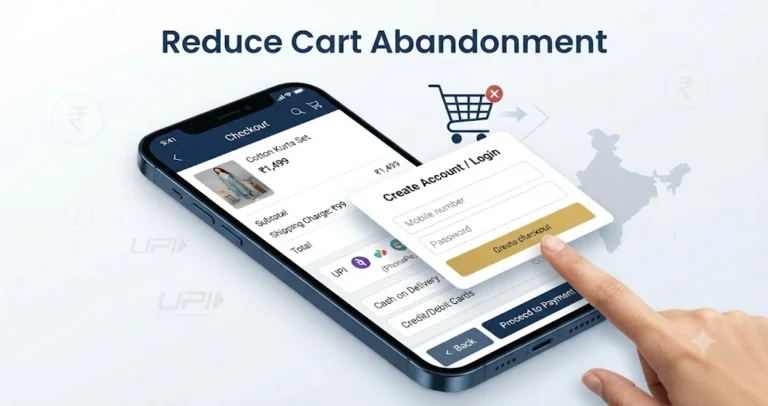
Cart abandonment can happen in seconds. A shopper adds a ₹1,499 kurta set to the cart at 11 pm, taps checkout, and sees a ₹99 shipping charge they didn’t expect. Then the site asks them to create an account. They close the tab and never come back.
To reduce cart abandonment on an Indian ecommerce store, remove everything that makes checkout feel slow, risky, or surprising. That means showing the full price early, offering guest checkout, putting UPI and COD up front, keeping payments reliable, and following up with shoppers who still leave. Most fixes are small, but they add up because every one of them improves the experience at the point where the customer is already ready to buy.
“Cart abandonment” is a bundle of different problems. Before changing anything, look at your funnel in GA4 (or your platform’s analytics) and see which step loses the most people:
If you only apply generic tips, you’ll fix the wrong step. A store losing people at the payment step needs a different fix from one losing them at the cart page.
Checkout friction is anything that makes the customer do more work, or feel more doubt, than the purchase deserves. On Indian stores, the usual culprits are:
Forced account creation. Allow guest checkout. A mobile number plus OTP is the lightest option, and most Indian shoppers are used to it. Don’t ask for a password at the same time. Let them create an account after the order is placed, if at all.
Long address forms. Ask for pincode first and auto-fill the city and state from it. Don’t make people type fields you can derive. Keep “address line 2” and “landmark” optional.
Late delivery checks. If you can’t deliver to a pincode, say so on the product page. Finding that out after typing a full address is one of the most irritating things a shopper can run into.
Surprise costs. Shipping, COD handling fees, and gift-wrap charges shouldn’t first appear on the last screen. Show an estimate in the cart, or state your free-shipping threshold clearly (“Add ₹300 more for free delivery”). A shopper who sees a cost early accepts it far more readily than one who finds it at the end.
A cluttered checkout page. Strip out the header menu, promo banners, and “you may also like” blocks. The page should have one job.
Payment is where Indian ecommerce differs most from Western playbooks. Customers here expect choice, and they punish failures.
Then check reliability. Look at your gateway dashboard (Razorpay, Cashfree, PayU, and similar providers all report this) and see what percentage of payment attempts fail, and why. A lot of “abandonment” is really a failed payment: a bank timeout, a UPI app that didn’t return, or a session that expired. If failures cluster on one method or one bank, fix or reroute that. Also make sure a customer who retries after a failure doesn’t have to refill the whole checkout.
Indian shoppers, especially buying from a store they haven’t used before, look for reassurance at the payment step. Make these visible near the pay button:
Only show what is actually true for your business. A fake “10,000+ happy customers” badge does more damage than leaving it off.
Some people will leave no matter what. Abandoned cart recovery is how you win back a share of them. It works best when it’s prompt, specific, and not spammy.
Cart recovery emails. This needs the shopper’s email or phone captured early, which is another argument for asking for contact details at the first checkout step. A workable sequence:
WhatsApp and SMS. These often get more attention than email in India, but they need proper consent from the customer (opt-in), and you should follow WhatsApp Business messaging rules and the DLT requirements for SMS. Keep messages short and send them only to people who agreed to hear from you.
Browse and exit-intent prompts. A prompt that asks a hesitating shopper what’s holding them back, whether that’s price, delivery time, or sizing, gives you better insight than guessing.
Don’t rebuild the whole checkout in a weekend. Pick the step in your funnel that loses the most people, make one change (say, enabling guest checkout, or moving UPI to the top), and compare completion rates over a few weeks. Make sure you have enough orders for the comparison to mean something. If your store gets low traffic, a longer window or a bigger change is more useful than several tiny experiments.
Keep a short log of what you changed and when. It’s the only way to know later which change moved the number.
Cart abandonment is one part of how an online store performs, alongside catalogue quality, ads, logistics, and the channel mix. If you’re still deciding where to sell, the question of selling on marketplaces versus your own website changes how much control you have over checkout in the first place. Our breakdown in Marketplace vs Own Website covers that trade-off. And if you’d rather have someone handle these fixes across your whole store, that’s what e-commerce management services in Delhi are for.
There’s no single reliable figure, because it varies by category, price point, traffic source, and device. A store selling ₹300 accessories to returning customers will look very different from one selling ₹40,000 appliances to first-time visitors. Compare against your own past numbers, step by step, instead of a headline benchmark.
Not automatically. COD can be the reason a hesitant first-time buyer completes the order at all. A better route is to look at your RTO rate by pincode and order value, then restrict COD or add a small fee only where losses are high, and give prepaid a small incentive.
For most stores, yes. Forced account creation adds a step right where the customer is closest to buying. You can still collect an email or number at checkout, and invite them to set a password after the order is complete.
Within a few hours is a sensible starting point, since the shopper still remembers what they wanted. Test it, though. Your customers may respond better to a different timing.
Common causes are bank-side declines, UPI app timeouts, an expired checkout session, and gateway downtime. Check your gateway dashboard for failure reasons and the methods that fail most, and make sure a failed payment lets the customer retry without re-entering everything.
Some changes, like moving UPI to the top, enabling guest checkout, or editing recovery emails, are settings on Shopify, WooCommerce, and similar platforms. Others, like pincode auto-fill or gateway rerouting, may need a developer or your gateway’s support team.
Free shipping often helps, but it isn’t free for you, so don’t apply it blindly. A free-shipping threshold (“Free delivery above ₹999”) can lift order value and reduce shipping-cost drop-offs at the same time. Check your margins first, and show the shipping cost or threshold in the cart instead of at the last step.
Yes, and for most Indian stores it matters a lot, because a large share of shoppers browse and buy on phones. Check that buttons are easy to tap, forms use the right keyboard (numeric for phone and pincode), UPI opens the payment app directly, and nothing important is hidden behind a sticky banner. Test the full checkout on a mid-range Android phone on a normal mobile connection, not only on your own laptop.
Yes, but only with proper consent. Customers should opt in to WhatsApp messages, and you need to follow WhatsApp Business messaging rules. For SMS in India, you have to follow DLT registration requirements. Keep messages short, relevant, and easy to opt out of. Email remains the simplest channel to start with.
Set up funnel or checkout-step reporting in GA4 or your platform’s built-in analytics (view cart, begin checkout, add shipping info, add payment info, purchase). Compare step to step to find the biggest drop. Then cross-check your payment gateway dashboard to separate real abandonment from failed payments. If your store has low traffic, review a longer period before drawing conclusions.
If your store is losing customers between cart and payment and you can’t tell where, send me your checkout flow and I’ll point out what to fix first. Call or WhatsApp 9289626386, or get in touch through ritwiksachdeva.in. I’m Ritwik Sachdeva, and I manage ecommerce stores for businesses in Delhi and beyond.