Why Purpose-Led Branding in India Is Winning Consumer Trust in 2026
Why Purpose-Led Branding in India Is Winning Consumer Trust in 2026 Purpose-led branding in India is winning trust because Indian...
Read More → 
THE BEST MARKETING CONSULTANT IN DELHI
Quick commerce is shrinking the gap between “I need this” and “it’s at my door” from days to about 10 to 30 minutes. For sellers, that changes how you price, pack, stock and list products. It also changes where you list them. The main shift is that inventory now has to sit physically close to the customer, and the quick commerce apps decide which products get that shelf space.
If you sell online in India, whether in grocery, personal care, snacks, stationery or small electronics, this affects you even if you’ve never listed on an instant delivery app.
Regular ecommerce works on a hub-and-spoke model. Your product sits in a large warehouse or your own store, and a courier picks it up and moves it through sorting centres before it reaches the buyer. Next-day or two-day delivery is considered good.
Quick commerce flips this. Platforms like Blinkit, Zepto and Swiggy Instamart run dark stores: small fulfilment points inside residential areas that aren’t open to walk-in customers. They stock a limited range of fast-moving products and serve only the few kilometres around them. When someone orders, a picker grabs the items in a couple of minutes and a rider covers the short distance.
Big marketplaces have noticed. Both Flipkart and Amazon have launched or tested their own instant delivery offerings, so this is no longer a niche side channel.
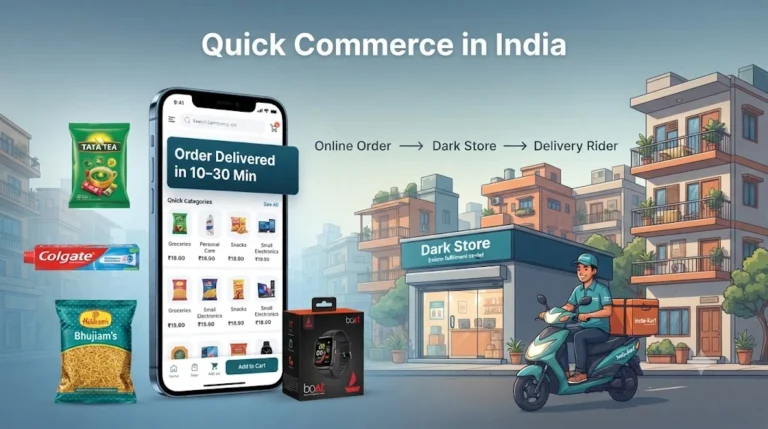
Dense cities, cheap delivery labour and smartphone habits made India a natural fit for on-demand retail. Three things drive the behaviour:
That last point matters most for sellers. Quick commerce is raising expectations on every channel, including your own website.
A dark store has limited space, so platforms stock fast-moving, easy-to-handle items. If your product is bulky, fragile, slow-selling or needs explanation before purchase, instant delivery apps are unlikely to be your main channel. Fast-moving consumables, compact packs and repeat-purchase products do best.
Pickers work in seconds. Clear labels, consistent barcodes, sturdy packaging and sensible pack sizes help. A confusing SKU structure causes mis-picks and returns, which hit your ratings and your relationship with the platform.
In regular ecommerce you can hold stock in one warehouse and ship nationwide. On instant delivery platforms, stock has to be positioned across many dark stores. Stockouts in one locality cost you sales there even if you have plenty elsewhere. Demand forecasting by city, and sometimes by neighbourhood, becomes part of the job.
Platform commissions, promotional contributions and ad spend inside these apps vary by category and by agreement, so check the actual terms rather than relying on rules of thumb. Visibility on an app’s small screen depends on category placement, search, ratings and sponsored slots. There’s no long page of results to scroll through, so being on the second row is a real disadvantage.
You probably can’t match 10-minute delivery from your own website, and you don’t need to. What you do need is clear delivery promises, reliable dispatch times and good order updates. Shoppers trained by instant delivery get less patient with vague “5 to 7 working days” messages.
Ask these questions before chasing a listing:
If the answers are mostly yes, start with a small hero range in one or two cities. Track sell-through and returns before expanding.
Quick commerce doesn’t replace your website or marketplace presence. It sits alongside them. A few things hold up regardless of channel:
Expect instant delivery to keep widening beyond groceries into beauty, electronics accessories, home essentials and gifting, and expect more brands to build products specifically for dark store shelves. Sellers who treat it as a distinct channel with its own inventory, pricing and packaging logic will do better than those who simply copy their marketplace listings across.
If you’re weighing quick commerce against your other channels and want help working out the numbers, product selection or listing setup, this is the kind of decision our ecommerce management services in Delhi are built around.
Often yes, but each platform has its own onboarding process, category requirements and commercial terms. Smaller brands usually get in through category-specific programmes or distributors, so check each platform’s seller or brand onboarding page first.
No. It started with groceries, but platforms have expanded into personal care, electronics accessories, stationery, home items and gifts. Groceries and daily essentials still account for most of the volume.
It can pull away some repeat or urgent purchases, especially where convenience matters more than choice. Products people research carefully before buying, like high-consideration electronics or furniture, are less exposed.
For most sellers, no. You can sell through existing platforms, or focus on your own channels with faster, clearer fulfilment. Running your own dark store only makes sense at serious scale in dense areas.
Compact, fast-moving, low-fragility items that people reorder: snacks, beverages, personal care, household basics and small accessories. Bulky, fragile or slow-selling products rarely get dark store shelf space.
Plan by city and locality demand, set reorder points for each location, and watch stockouts closely. If you’re unavailable in one area, you lose those sales entirely, even if you have plenty of stock elsewhere.
Marketplaces ship from large warehouses over days. Quick commerce depends on stock placed in small neighbourhood dark stores, so inventory positioning, pack sizes and stock availability matter far more. Visibility is also tighter, because app screens show fewer products at a time.
It depends on the platform, category and your agreement. Commissions, promotional contributions and in-app advertising all vary, so ask for the current terms in writing and work out your margin per SKU before committing.
Start where dark store networks are densest and your customers already are. Delhi NCR, Mumbai and Bengaluru generally have deeper coverage than smaller towns. Begin with one or two cities and a small hero range, then expand based on sell-through.
Yes. Shoppers used to instant delivery are less patient with vague timelines. Clear delivery promises, reliable dispatch, good order updates and a smooth checkout help you stay competitive even without 10-minute delivery.
Not sure whether quick commerce suits your catalogue? Visit ritwiksachdeva.in or call 9289626386 for a straightforward conversation about your products, channels and next steps.