Why Purpose-Led Branding in India Is Winning Consumer Trust in 2026
Why Purpose-Led Branding in India Is Winning Consumer Trust in 2026 Purpose-led branding in India is winning trust because Indian...
Read More → 
THE BEST MARKETING CONSULTANT IN DELHI
PPC landing page alignment means the page a visitor lands on continues the exact promise, keyword and offer of the ad they just clicked. When the two match, visitors stay, Google rates your page as relevant, and your cost per lead usually falls. When they don’t, you pay for the click and lose the visitor within seconds.
Most advertisers audit ads endlessly and never look at the page. That’s where a lot of ad budget quietly disappears.
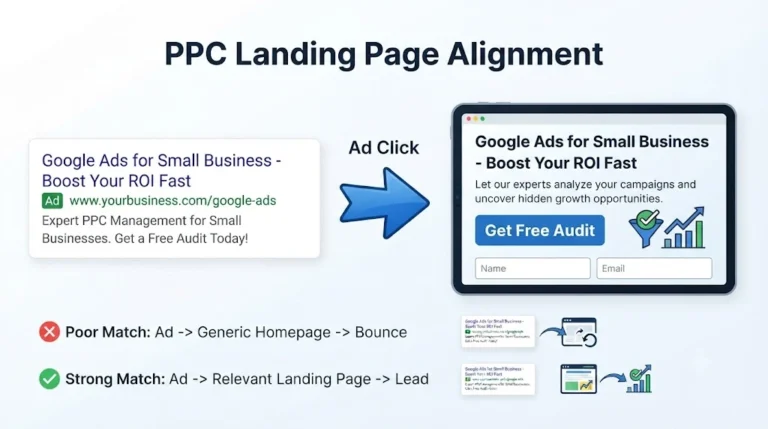
Picture this. Someone searches “google ads for a small furniture store,” clicks your ad, and lands on a homepage with a slider about “digital marketing solutions for every industry.” The ad promised something specific, and the page makes them hunt for it. Most people won’t hunt. They hit back, and you’ve paid for a visit that had no chance.
The ad platform can only get someone to your door. What they find inside decides whether you get an enquiry or just an invoice from Google. If you want the bigger picture of how campaigns are built and managed, my PPC expert in Delhi page covers it. This post focuses on the part people skip.
Google Ads scores your keywords on three factors: expected click-through rate, ad relevance, and landing page experience. The first two live in your ad. The third lives entirely on your page.
A weak landing page experience drags the whole score down, even if the ad itself gets clicks. A lower Quality Score generally means you pay more per click for the same position, or you lose auction position to a competitor with a more relevant page.
The quality score landing page factors Google has described publicly include:
None of these are exotic. They’re the basics, and many campaigns still miss them.
Message match means the headline on the page echoes the ad’s headline and the searcher’s intent. It’s the simplest change with the most visible effect.
If your ad says “Free Google Ads Audit for Online Stores,” the page headline shouldn’t read “Welcome to Our Digital Agency.” It should say something close to “Get a Free Google Ads Audit for Your Online Store.” Same offer, same words, same audience.
A quick test: cover the URL and read only the ad and the page headline. Would a stranger believe they belong together? If not, fix the page.
Some practical ways to tighten it:
Here’s a common mistake: one landing page for the whole account. It’s convenient, but it forces one page to answer completely different searches.
Someone searching “PPC agency” wants a service page. Someone searching “how to lower cost per click” wants advice. Someone searching “google ads audit” wants a specific offer. These are different intents, and a single generic page serves none of them well.
You don’t need fifty pages. Start by grouping keywords by intent and give each group its own page or a clearly tailored variation. Even three focused pages usually beat one catch-all. This structure also makes your budget allocation decisions cleaner, because you can see which intent group actually produces leads and shift spend toward it.
Once the message matches, the page still has to earn the conversion. A strong post-click experience usually comes down to a handful of things done properly.
One goal per page. If the goal is a form submission, don’t surround it with links to your blog, your about page and your careers page. Every extra exit is a chance to lose the visitor.
Answers above the fold. The top of the page should tell the visitor what you offer, who it’s for, and what to do next, without scrolling.
A form that respects effort. Every extra field lowers the chance someone finishes it. Ask only for what you need to follow up. Name, phone and one qualifying question is often enough.
Speed on mobile. A large share of ad traffic arrives on phones. Heavy images, pop-ups that cover the screen and tiny tap targets can undo good ad work. Test the page on a real phone over a normal connection, not just on your office wifi.
Proof that’s real. Reviews, client results and certifications build trust, but only when they’re genuine and can be verified. If you don’t have them yet, use specifics instead: explain exactly how your process works, what the visitor will get, and how long it takes. Vague claims like “best in class” convince nobody.
Clear next step. “Get my free audit” beats “Submit.” Say what happens after the click.
You don’t need a full audit to spot the warning signs. Check for these in your account:
A high CTR with low conversions is the classic pattern. It means the ad is doing its job and the page isn’t.
Before you increase budget on any campaign, walk through this:
That last tracking point matters more than people think. If conversions aren’t measured properly, you can’t tell whether a page is failing or the data is.
When results are weak, the instinct is to spend more. But adding budget to a misaligned campaign just buys more of the same bounce. Fixing message match and page experience first means each extra rupee works harder, whether that shows up as more leads at the same spend or the same leads at lower cost.
It can. Landing page experience is one of the three components of Quality Score, and Quality Score influences your ad rank and the cost you pay to hold a position. It’s not the only factor, but a poor page makes everything else harder.
You can, but it’s rarely the best choice. Homepages try to serve every visitor, so they seldom match a specific ad’s promise. A page built for one offer and one audience almost always converts better.
As many as you have distinct intents, not distinct keywords. Group related keywords, give each group a page that speaks to it, and expand only when the data shows it’s worth it.
Long enough to collect a meaningful number of clicks and conversions, not just a couple of days. Changing several things at once also muddies the result, so test one meaningful change at a time where you can.
Check the page first if your click-through rate is healthy. Look at message match, mobile speed, form length, and whether your phone number or button is visible without scrolling. Also confirm that call and form tracking is actually working.
Yes, especially on mobile. Visitors from ads have little patience, and a slow page loses them before your headline even loads.
In Google Ads, add the Quality Score columns at the keyword level. Landing page experience is shown as below average, average, or above average for each keyword. If a keyword is rated below average, start by checking whether the page truly matches what that keyword’s searcher wants.
There’s no single number that fits everyone, because it varies by industry, offer, traffic source, and what counts as a conversion. A more useful benchmark is your own: track your conversion rate per ad group, then improve the weakest pages first and compare against your past results.
Yes. The Quality Score itself is a Google Ads concept, but the underlying idea applies everywhere. If someone clicks an ad for one thing and lands on a page about something else, they leave, whichever platform sent them. Matching the ad’s message, offer, and audience to the page helps on every paid channel.
In most cases, yes. Extra budget sent to a misaligned page just buys more bounces. Once the page matches the ad and converts properly, you can decide where extra spend should go using the approach in my guide to PPC budget allocation.
If your clicks are coming but your enquiries aren’t, the gap is often between the ad and the page. I’m Ritwik Sachdeva, and I help Delhi businesses fix exactly this. Send me your ad and landing page, and I’ll tell you where the message breaks and what to change first.
📞 9289626386 | 🌐 ritwiksachdeva.in
Or see how the full service works on the PPC expert in Delhi page.