Why Purpose-Led Branding in India Is Winning Consumer Trust in 2026
Why Purpose-Led Branding in India Is Winning Consumer Trust in 2026 Purpose-led branding in India is winning trust because Indian...
Read More → 
THE BEST MARKETING CONSULTANT IN DELHI
First-party data PPC means running paid campaigns on information people have knowingly given you (emails, phone numbers, purchase history, on-site preferences) instead of on third-party cookies and purchased audience lists. In India this is no longer just a smart move. The Digital Personal Data Protection (DPDP) Act and its Rules are turning consent and data handling into a legal obligation, right when browser-level tracking is getting weaker. If your ad accounts run on data you can’t explain the origin of, that’s the thing to fix first.
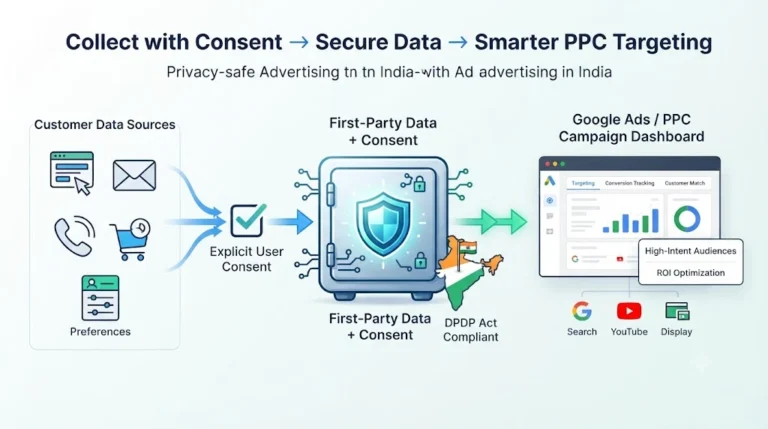
Two shifts are happening at the same time, and they’re often mixed up.
The first is technical. Safari and Firefox already block third-party cookies by default, and a growing share of Indian mobile users opt out of app tracking. Retargeting pools built on cookies keep shrinking, and conversion reports look patchier every quarter.
The second is legal. India’s DPDP Rules were notified in November 2025 with a phased rollout. The main obligations, including notice and consent requirements and data principals’ rights, apply 18 months later, by May 13, 2027. Penalties for non-compliance by a data fiduciary can go up to INR 250 crore. Most small and mid-sized advertisers won’t see anything near that number, but the direction is clear: “we got the list from somewhere” won’t be an acceptable answer.
The window until May 2027 is your runway. Accounts rebuilt now will have consented, documented audiences ready when enforcement begins. Accounts that wait will be doing it in a panic.
Cookieless targeting sounds like a new discipline, but it’s mostly a return to basics. Here’s what holds up:
Collection is where most advertisers go wrong, because they treat it as a form-design problem rather than a consent problem. The Rules require clear consent before personal data is collected, and pre-ticked boxes, bundled permissions and implied consent are prohibited. Notices must also say what data is collected, why it’s needed, and how consent can be withdrawn.
For a PPC account, that translates into a few practical habits:
Consent mode is a way of telling Google’s tags what the visitor agreed to, so tags adjust their behaviour accordingly. When a visitor declines, Google can still model some of the lost conversions from aggregated, non-identifying signals instead of dropping them entirely.
Where advertisers slip up is in treating the cookie banner as decoration. If the banner says “Accept” but your tags fire regardless of the choice, you’ve built a compliance problem that also corrupts your data. Set it up so that:
Consent mode won’t recover every lost conversion. It gives you a defensible baseline, which matters more than a perfect one.
Customer Match lets you upload hashed customer details (email, phone) to Google Ads, and Meta has an equivalent in Custom Audiences. The platform matches them to signed-in users so you can target, exclude or build lookalikes.
The real value isn’t only in reaching existing customers. It’s in these three uses:
Two cautions. Platforms set eligibility conditions for Customer Match, so check your account meets them before planning a campaign around it. And only upload people who gave consent for this use.
This also connects directly to smart bidding. Automated strategies are only as good as the conversion data you give them, which is why the quality of your first-party signals now decides how well AI bidding performs.
Zero-party data is information a customer volunteers on purpose: a skin-type quiz answer, a stated budget, a preferred delivery slot, a product category they want alerts for. It’s different from behavioural data because nobody has to guess what it means.
For an ecommerce store, a three-question quiz on a landing page can do more for segmentation than months of pixel data. Someone who tells you they’re buying for a gift, under ₹2,000, needed in a week, is easy to write an ad for. The consent is also clean, because the person handed it over knowing why.
A data clean room lets two parties (say, an advertiser and a platform or retailer) match audiences and measure overlap without either side seeing the other’s raw customer records. Google Ads Data Hub and Amazon Marketing Cloud are examples.
Being honest here: for most Indian SMEs and mid-market brands, clean rooms are overkill today. They need volume, engineering time and a clear question to answer. Consider them if you have a large customer base, you sell across several channels, and you need cross-platform measurement that ad platforms’ own reports can’t give you. Otherwise, spend the effort on consent capture and Customer Match hygiene first.
This is the same groundwork I describe on the PPC expert in Delhi page, where consent-safe data comes first and bidding and creative build on top of it.
No. It means you need a valid basis, in practice clear consent, for using personal data for advertising, and you need to be able to show it. Lists collected for a different purpose, or with unclear consent, are the risky ones.
Anything a person shares directly with your business: email addresses, phone numbers, purchase history, form enquiries, app activity and on-site quiz answers. Data bought from a broker or scraped from somewhere else is not first-party, even if it sits in your CRM.
Google’s consent-signal requirements have been strongest for users in the EEA and UK. In India it isn’t a stated legal requirement, but it gives you a consent-respecting setup and modeled conversions ahead of the DPDP deadlines, so it’s worth implementing now.
Yes, but on a smaller and more consent-dependent pool than before. Rely on your own audience lists and consented on-site signals rather than expecting third-party cookies to fill the gaps.
Platforms set minimum match thresholds, and the numbers can change, so check the current requirements inside your account. Even a small list is useful for exclusions, such as keeping existing buyers out of acquisition campaigns.
It’s the safer route. Someone sharing their number for an order update hasn’t necessarily agreed to be added to an ad audience. A clear, unticked marketing checkbox with a plain-language purpose keeps that consent separate and easy to prove.
Trace where each one came from. If you can’t show how or why the data was collected, or the consent doesn’t cover advertising, stop using it for targeting and consider deleting it. Rebuild with fresh, documented consent instead of carrying old risk into your new setup.
You need to stop using their data for that purpose. For PPC, that means removing them from Customer Match uploads and remarketing lists at your next refresh, and it helps to schedule that refresh rather than leave it to memory.
Yes. The DPDP framework treats children’s data more strictly, including limits on tracking and targeted advertising aimed at children. If your product or audience could include under-18s, get proper advice on how it applies to your campaigns before targeting them.
No, but don’t treat it as distant either. Consent flows, tag setups and list clean-ups take weeks to do properly, and the earlier you start, the fewer things you’ll rebuild under pressure.
If you’re unsure whether your current lists, tracking and consent setup would hold up, I can walk through your account with you and point out what needs fixing first. No pitch deck, just a practical look at what’s in place.
Ritwik Sachdeva, PPC & ecommerce management, Delhi
📞 9289626386 | 🌐 ritwiksachdeva.in