Why Purpose-Led Branding in India Is Winning Consumer Trust in 2026
Why Purpose-Led Branding in India Is Winning Consumer Trust in 2026 Purpose-led branding in India is winning trust because Indian...
Read More → 
THE BEST MARKETING CONSULTANT IN DELHI
PPC budget allocation works best when you split spend by job, not by platform popularity. Google Search captures people who already want something, Meta creates and nurtures demand, and YouTube builds the familiarity that makes both of the others cheaper to convert. A sensible starting split for most accounts is to put the largest share on whichever platform sits closest to the sale, then fund the others in proportion to how much demand you need to create.
Most advertisers do the opposite. They pick a monthly number, divide it into thirds, and wonder six weeks later why one channel eats the budget while another shows nothing. Here’s how to set the split properly.
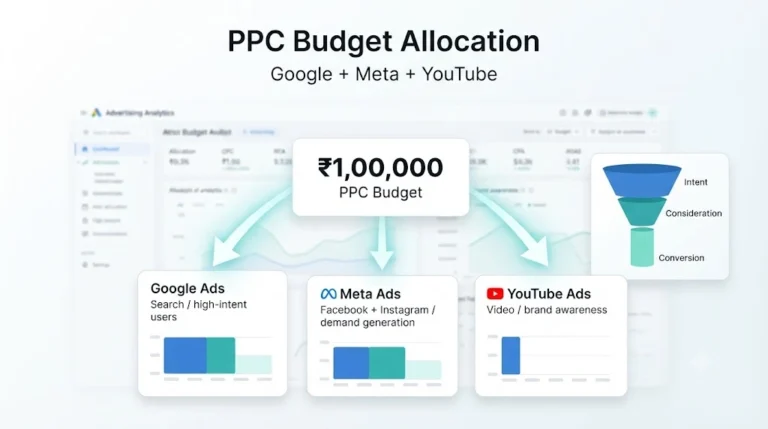
Before comparing platforms, map how your buyers actually behave.
The channel closest to the moment of decision deserves your largest share. The other channels earn budget by feeding it. This is the core of media mix planning, and everything below builds on it.
Search campaigns reach people typing a specific need. That makes them the easiest place to prove ROI, and usually the first place budget should go. The limit is volume. You can only spend as much as people actually search for. Once you’ve covered every relevant query, adding budget just raises your cost per click.
Shopping and Performance Max sit here too for product businesses, but they follow the same rule: they harvest demand more than they create it.
Facebook and Instagram let you reach people who haven’t searched for you and probably don’t know you exist. That’s a different job from Search. Cold Meta traffic converts at a lower rate than search traffic, so judging Meta on last-click sales alone will make it look weaker than it is. Its real strengths are prospecting with strong creative, and retargeting people who visited your site or watched your videos.
YouTube is the slowest-burning of the three. It works for higher-consideration purchases, where people want to see the product, the person, or the process before committing. It also works when your category is crowded and you need to be remembered. Don’t expect it to look like Search in a dashboard. View-through activity and branded search growth are often where its impact shows up.
There’s no universal ratio, and anyone quoting one without knowing your margins and sales cycle is guessing. These are starting positions to test, not benchmarks:
Business situation | Where the biggest share goes | Supporting role |
Local service, urgent need (repairs, clinics, legal) | Google Search | Meta retargeting; small YouTube if trust matters |
Ecommerce, impulse or visual product | Meta | Google Shopping and brand search; YouTube for launches |
High-ticket or considered purchase (B2B, education, real estate) | Google Search plus YouTube | Meta for retargeting and lead nurturing |
New brand nobody searches for yet | Meta and YouTube | Google brand and category search as demand appears |
A new brand with almost no search volume can’t lean on Search, because there’s little to capture. An established local service with steady search demand can put most of its budget there and keep Meta lean.
You’ll often see advice to put roughly 70% on proven channels, 20% on channels you’re scaling, and 10% on experiments. It’s a useful discipline because it stops you from either over-committing to something unproven or starving your tests. But treat it as a habit, not a rule. If you’re spending ₹30,000 a month total, 10% is ₹3,000, which is too little to learn anything from on YouTube. In that case, test one channel properly for a fixed window rather than spreading thin.
Before you move money between platforms, check three things that quietly decide whether spend gets wasted.
Tracking. If conversions aren’t tracked consistently across platforms, you’ll over-credit whichever one is easiest to measure, which is usually Google Search. Set up conversion tracking properly in Google Ads, the Meta pixel or Conversions API, and analytics before you compare anything.
Minimum data. Each campaign needs enough daily budget to gather meaningful conversions. A campaign spending too little to exit its learning phase produces noisy data, and you’ll make bad decisions from it. Fewer campaigns with adequate budgets beat many thin ones.
The page people land on. Budget can only perform as well as the destination lets it. A campaign sending Meta traffic to a page written for Google searchers wastes money that no reallocation will fix. This is covered properly in our guide to landing page alignment, and it’s worth reading before you start shifting spend around.
Once you have real numbers, look at these in order:
Move budget in modest steps, roughly 10–20% at a time, and give each change a couple of weeks. Large swings reset learning and make it impossible to tell what worked.
Budget allocation is one decision inside a larger system that also covers structure, bidding, creative, and measurement. If you want the full picture of how these pieces connect, see the main guide from a PPC expert in Delhi.
It depends on whether your customers search for what you sell. If they do, start with the larger share on Google Search and use Meta to retarget and widen reach. If your product is new or visual and few people search for it yet, lead with Meta and add Google as search demand grows.
Usually not well. Below a certain level, each campaign gets too little data to optimize, and you end up making decisions from noise. Run one or two channels properly first, then add the third once those are stable.
It can be, especially for considered purchases and crowded categories where trust matters. It’s rarely the right first channel if you need leads this month, because its impact tends to show up later, in branded searches and warmer retargeting audiences.
Give each channel a few weeks of stable spend and working tracking before drawing conclusions. Short sales cycles may show patterns sooner, while longer ones (B2B, education, real estate) need more time. Avoid changing things every few days.
No. Seasonality, festive periods and industry peaks change both demand and cost. Review the split monthly and shift it in small steps instead of holding one fixed ratio.
Google Search captures people who already want to buy, so it often gets the last click. Meta usually starts the journey earlier, and last-click reporting under-credits it. Look at branded search growth and retargeting performance before deciding Meta isn’t working.
On Google, check impression share lost to budget on campaigns that are already profitable. On Meta, look at whether campaigns are stuck in the learning phase because daily budget is too low to gather enough conversions. Both are signs the channel is starved, not failing.
Small shifts, roughly 10–20% at a time, are easier to read and less likely to reset campaign learning. Large swings make it hard to tell what actually caused a change in results.
Yes, a lot. Traffic from Meta and traffic from Google arrive with different intent, so sending both to the same page often wastes spend on one of them. Fix the page match first, then judge each channel. See our guide on landing page alignment.
If your spend is small and you have one channel, managing it yourself is realistic. Once you’re running multiple platforms, the tracking, attribution and rebalancing decisions get tricky enough that an outside view can save more than it costs. You can talk to a PPC expert in Delhi about your own numbers.
Every business has a different sales cycle and margin structure, and a split that works for one can drain another. If you’d like a second opinion on your current mix, I’m happy to look at it with you.
Ritwik Sachdeva — Delhi-based ecommerce and PPC management
Call: 9289626386
Web: ritwiksachdeva.in