Why Purpose-Led Branding in India Is Winning Consumer Trust in 2026
Why Purpose-Led Branding in India Is Winning Consumer Trust in 2026 Purpose-led branding in India is winning trust because Indian...
Read More → 
THE BEST MARKETING CONSULTANT IN DELHI
Performance Max vs Manual Campaigns is a common decision for Delhi-based D2C brands managing Google Ads. A brand may switch its entire budget to Performance Max, watch conversions spike for six weeks, and then quietly stall—with no clear visibility into which audience, placement, or creative actually worked. Meanwhile, a competitor running tightly segmented manual campaigns can see, line by line, why a click became a sale. Both approaches can work. The real difference comes down to what you’re optimizing for and how much control you’re willing to give up for automation.
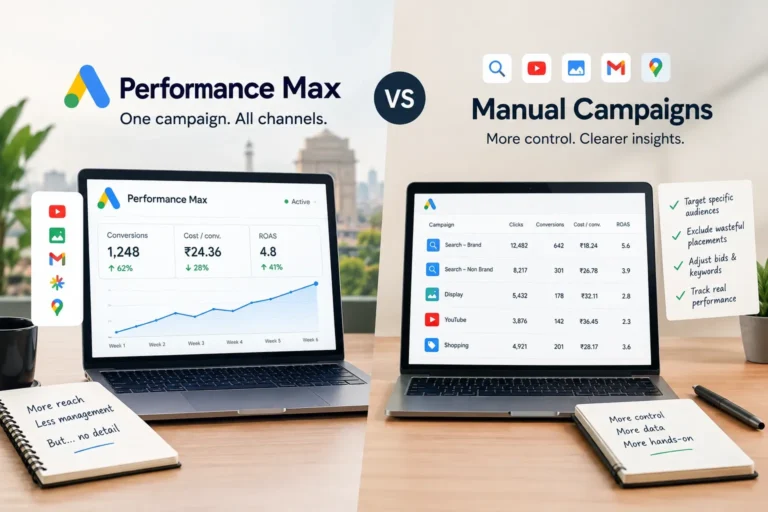
Google Performance Max is an automation-first campaign type that runs across every Google inventory — Search, Display, YouTube, Gmail, Discover, and Maps — from a single campaign. You feed it assets (headlines, images, video, creative combinations) and business goals, and Google’s AI bidding decides where your budget goes, who sees your ads, and how much to bid per auction in real time.
The appeal for Delhi businesses is obvious: one campaign instead of five, less day-to-day management, and access to cross-network reach that would take weeks to build manually. For a local business trying to cover Search, Display, and YouTube without a full-time in-house team, that’s a real advantage.
The trade-off is equally real. Performance Max gives you almost no placement-level or audience-level reporting. You know overall performance, not which channel or segment drove it. If you’re running promotions specific to, say, Karol Bagh footfall versus Gurgaon delivery zones, PMax won’t let you split that cleanly.
Manual campaigns — standard Search, Display, or Shopping campaigns built and managed by a person — trade automation for visibility. You choose keywords, set bids, exclude placements that don’t convert, and adjust based on what the data actually shows you.
For a Delhi business with a specific ICP — say, a B2B service targeting only South Delhi enterprises, or a retailer running different offers by pin code — manual control lets you build that logic directly into the campaign structure. You can pause a keyword the moment it stops converting. You can’t do that inside Performance Max; you can only adjust the asset group and wait for the algorithm to react.
Manual campaigns also demand more time. Someone needs to actually watch search terms, test ad copy, and prune wasted spend weekly. Left unmanaged, a manual campaign underperforms PMax by a wide margin — the “control” only pays off if someone is actually using it.
The honest framing isn’t “which is better” — it’s “which matches your business right now.”
Performance Max tends to work better when:
Manual campaigns tend to work better when:
A lot of Delhi businesses I’ve worked with land somewhere in between — running Performance Max for broad top-of-funnel reach while keeping a manual Search campaign for their highest-intent, branded, or highest-margin keywords. That split gives you automation’s efficiency where it doesn’t hurt, and manual precision where it matters most.
Google’s AI bidding — whether inside PMax or applied to manual campaigns via Smart Bidding — is genuinely good at real-time auction-level decisions no human can match: adjusting bids by device, time of day, and micro-signals across thousands of auctions per second.
What it’s not good at is business context the algorithm never sees — inventory constraints, margin differences between products, or a regional promotion running only in certain areas. That context has to be built into campaign structure and asset groups manually, before the automation takes over. Automation and manual strategy aren’t opposites; one sets the boundaries, the other operates within them.
Yes, and it’s often the right approach — just make sure to exclude overlapping keywords so you’re not bidding against yourself in the same auction.
There’s no official minimum, but accounts with limited conversion history typically see slower, less reliable results until the algorithm has enough signal to learn from.
Not really — the advantage of manual control comes from active management. Without regular oversight, it usually underperforms a well-set-up automated campaign.
Neither is inherently cheaper — cost depends on how well each is set up and managed. A poorly managed manual campaign can waste more budget than PMax, and vice versa.
Not directly. PMax gives you search term insights and asset-level performance signals, but it won’t break results down by exact keyword the way a manual Search campaign does.
A new account with no conversion history usually benefits from starting manual — it lets you build a clean data foundation and understand what’s actually converting before handing decisions over to automation.
It supports location targeting, but not the same granularity as manual campaigns. If your offers genuinely differ by micro-location, manual control makes it easier to manage that split.
There’s no fixed rule, but assets that stop performing (marked “low” in Google Ads’ asset report) should be refreshed rather than left running — stale creative drags down the whole asset group’s delivery.
It can. PMax campaigns typically go through a learning phase after launch or major changes, during which performance can be less stable before the algorithm optimizes.
Largely, yes — PMax doesn’t support the same negative keyword lists as Search campaigns. Account-level negative keyword lists offer some control, but it’s far less precise than manual exclusions.
The Performance Max vs manual debate isn’t really about picking a side — it’s about understanding your own data, audience segmentation, and how much hands-on management your team can realistically commit to. If you’re deciding how to structure this for your own account, a proper campaign audit usually settles it faster than trial and error — and if you’ve read the earlier piece on where AI genuinely helps in performance marketing, this comparison should make the practical trade-offs a lot clearer.
If you want a second opinion on your current Google Ads setup — what’s worth automating and what needs manual control — reach out to Ritwik Sachdeva at 9289626386 or visit ritwiksachdeva.in for a quick account review.