Why Purpose-Led Branding in India Is Winning Consumer Trust in 2026
Why Purpose-Led Branding in India Is Winning Consumer Trust in 2026 Purpose-led branding in India is winning trust because Indian...
Read More → 
THE BEST MARKETING CONSULTANT IN DELHI
If you’re only running paid social ads, you’re renting attention. If you’re only posting organically, you’re hoping the algorithm notices you. The right mix of organic vs paid social media almost always beats either one alone — organic builds trust and keeps costs down over time, paid social ads get you in front of the right eyeballs now, while the algorithm is busy deciding whether your brand even deserves reach.
Most brands don’t actually have a “which one” problem. They have a “how much of each, and when” problem. That’s what this piece is really about.
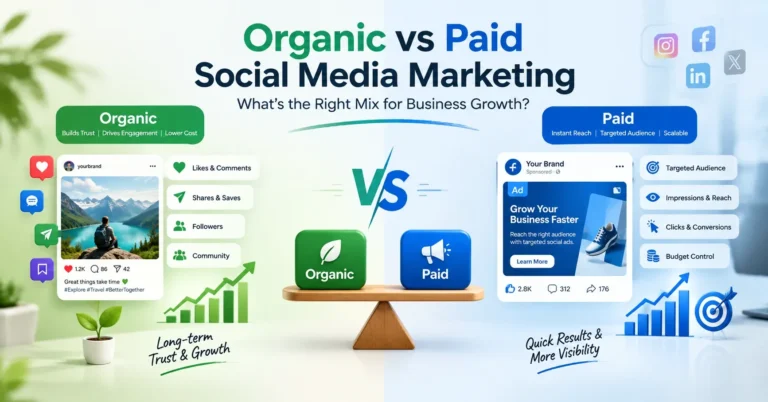
Paid and organic aren’t just two channels — they optimize for two different outcomes, and confusing them is where most social media marketing strategy plans go wrong.
Paid social is a reach machine. You set a budget, pick an audience, and the platform shows your content to people who’ve never heard of you. It’s fast, it’s scalable, and it’s brutally efficient at getting a message in front of a specific number of eyeballs on a specific day. What it’s not good at, on its own, is making people trust you. A cold audience seeing a paid ad for the first time is still evaluating whether you’re legitimate.
Organic content does the opposite job. It’s slower, and reach is capped by whatever the algorithm decides to show your existing followers — but the people who do see it are already somewhat warm. They followed you, or the algorithm nudged your content toward someone with a genuine interest in your niche. Comments, saves, shares, DMs — that’s engagement, and it’s a trust signal that ads alone rarely generate.
Here’s the practical version: paid social ads vs organic isn’t a fight to pick a winner. Paid gets the stranger to notice you exist. Organic gets that same person to believe you’re worth buying from. Run paid without organic and you’re constantly paying to re-introduce yourself to people who forget you the moment the ad stops. Run organic without paid and you’re capped by however many people already follow you — which, for most growing brands, isn’t enough to hit real revenue targets.
There’s no universal “70/30” rule that works for every business, no matter how many templates claim otherwise. Budget allocation between organic and paid should shift based on three things: how new the brand is, how competitive the category is, and what the business actually needs right now — awareness, leads, or repeat sales.
Early-stage or new-to-social brands typically need to lean paid-heavier in the first few months. There’s no existing audience for organic content to reach, so even great content sits with minimal visibility. A reasonable starting range is 60-70% paid, 30-40% organic effort (time and content production, not just spend) — with the organic side building the content library and brand voice that paid ads will later amplify.
Established brands with an existing audience can flip that ratio. Once organic content already has a base that engages, paid budget works better spent boosting the organic posts that are already proving themselves — rather than building ads from scratch. This is often where a 40-60% paid-to-organic-effort split starts to make more sense.
High-competition categories — where cost-per-click is already inflated — need organic to carry more of the “trust-building” weight, because outbidding competitors purely on paid reach gets expensive fast. In lower-competition niches, paid can carry more weight because there’s less noise to cut through.
The mistake to avoid: treating budget allocation as a one-time decision. It should be revisited quarterly, based on what the data is actually showing — not on what felt right when the plan was first written.
This is the piece that gets ignored most often, and it’s the one that causes the most frustration.
Paid social is a short-term-results channel. Turn the budget on, traffic and conversions show up within days. Turn it off, and that traffic disappears almost as fast — because you were never building an owned audience, you were renting one. That’s not a flaw; it’s exactly what paid is for. Use it when the business needs revenue or visibility this month, not in six.
Organic is a long-term-results channel. It compounds. A post that ranks well or resonates can keep bringing in engagement and even sales for months. An audience built organically keeps costing nothing to reach, campaign after campaign, unlike paid audiences you have to re-pay for every single time. But organic almost never produces a spike — it builds a slope. Brands that expect organic to behave like paid (fast, immediate, measurable in a week) usually give up on it just before it starts compounding.
The businesses that get the mix right treat paid as the channel for this quarter’s numbers and organic as the channel building next year’s lower cost-per-acquisition. Neither replaces the other; they’re solving for different timelines on the same growth curve.
Instead of asking “organic or paid,” ask these three questions about the specific business:
There isn’t a single right answer here — the right mix is specific to the brand, the category, and where the business is right now. That’s usually where a dedicated Social Media Marketing Agency earns its keep — not by picking organic or paid as a philosophy, but by running both in a way that’s actually tied to what the numbers are showing month to month.
Getting the organic-to-paid ratio right is only half the equation — the other half is whether the paid budget itself is being spent well. Poorly targeted, poorly tested paid campaigns can burn through budget without ever giving organic content the runway to compound. This is usually where working with a Performance Marketing Consultant makes a measurable difference — sharpening targeting, testing creative faster, and making sure paid spend is actually buying results instead of just impressions.
Neither wins outright, but a new business usually needs paid to get initial visibility while organic content is still building an audience from zero. Once there’s an existing engaged following, the balance can shift more toward organic-led with paid support.
It depends on how established the brand is and how competitive the category is — there’s no fixed ratio. Newer brands often lean 60-70% paid initially; established brands with an existing audience can often flip that ratio toward organic-led, paid-supported.
For most businesses, no — organic reach is capped by the algorithm and by however large the existing audience already is. Paid remains the fastest way to reach people who don’t already follow the brand.
Because paid reach is rented, not owned. The audience seeing the ads was never following the brand independently, so once spend stops, so does the visibility. This is exactly why organic content matters — it’s the only channel that keeps compounding after the campaign budget runs out.
Quarterly at minimum. Category costs, competition, and audience size all shift, and a split that made sense six months ago can quietly become inefficient if it isn’t reviewed against current performance data.
Organic first, in most cases. Posts that already get genuine engagement organically make far stronger ad creative than something built cold for paid, because they’ve already proven people respond to them before any budget was spent boosting them.
Indirectly, yes. Paid campaigns can drive new followers, profile visits, and engagement that feed into how the algorithm treats future organic posts from the same account. It’s not a direct boost, but an account with more genuine engagement signals generally sees organic content travel a little further.
Treating paid as a fix for organic content that isn’t working. If a post underperforms organically because the message or offer isn’t landing, boosting it with paid spend usually just gets a weak message in front of more people faster — it doesn’t fix the underlying problem.
Only the ones already showing signs of working — decent engagement rate, comments, saves — should get paid boost behind them. Boosting an average-performing post rarely turns it into a strong one; it mostly just spends budget on the same average result at a larger scale.
Look past vanity metrics like impressions. Track cost-per-acquisition trends over time (should trend down as organic audience grows), engagement rate on organic posts, and how much paid spend is going toward re-engaging people who’ve already interacted with the brand organically versus pure cold outreach.
Want a mix that’s actually built around your numbers, not a generic template? Message Ritwik Sachdeva on WhatsApp/call at 9289626386, or check out the work at ritwiksachdeva.in for a free look at where your current organic-to-paid split stands.