Why Purpose-Led Branding in India Is Winning Consumer Trust in 2026
Why Purpose-Led Branding in India Is Winning Consumer Trust in 2026 Purpose-led branding in India is winning trust because Indian...
Read More → 
THE BEST MARKETING CONSULTANT IN DELHI
Most brands don’t lose engagement because their content is bad — they lose it because of small, repeatable social media optimization errors that quietly cap reach before the algorithm even gets a fair shot at the post. If your likes, shares, and comments have been flatlining despite consistent effort, the problem is usually one of a handful of fixable habits.
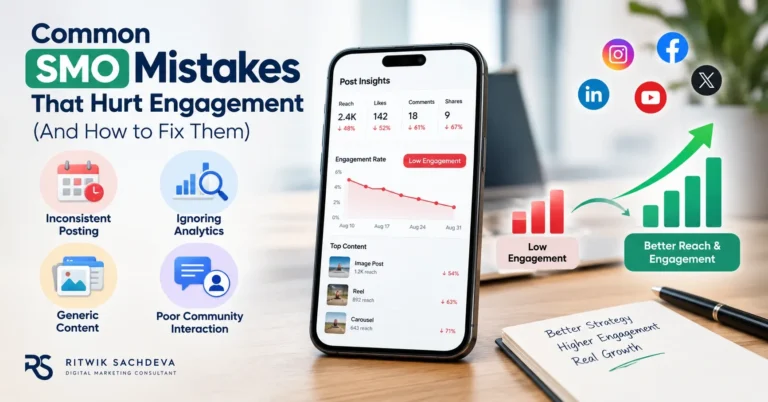
Social platforms reward accounts that show up predictably. When posting frequency swings from daily to once a week and back again, the algorithm has no pattern to learn from, and neither does your audience. Followers stop expecting your content in their feed, which means fewer of them are actively looking for it — and that drop in anticipation shows up directly as lower reach on the posts that do go out.
A simple content calendar, even a basic one mapped out two weeks at a time, solves most of this. It’s not about posting more; it’s about posting on a rhythm your audience can rely on.
A lot of accounts publish, check likes once, and move on. That’s not optimization — that’s guessing. Real social media optimization means looking at when your audience is actually online, which post formats they engage with (carousel vs. reel vs. static image), and where people drop off in a video’s watch time.
Without that feedback loop, you end up repeating whatever “felt right” instead of what’s actually working. Even 15 minutes a week spent in the platform’s native analytics — Instagram Insights, YouTube Studio, whatever applies — tells you more than another week of posting blind.
Templates and trends are useful starting points, but when every post looks like it could belong to any brand in the niche, there’s nothing pulling a scroll to a stop. Generic content fails on two levels: it doesn’t stand out visually, and it doesn’t say anything specific enough to prompt a comment or share.
The fix isn’t more polish — it’s more specificity. A post about your actual process, an opinion your brand is willing to stand behind, or a real customer scenario will consistently outperform a beautifully designed but interchangeable graphic.
Posting and disappearing is one of the most common low engagement causes. Comments left unanswered, DMs ignored, and no replies to shares all send a signal — to both your audience and the platform — that there’s no one actually behind the account. Engagement is a two-way signal; platforms weigh reply activity and interaction speed when deciding how far to push a post.
Setting aside a fixed window each day — even 20 minutes — to reply to comments and engage with accounts that engage with you keeps that loop alive, and it’s often the single cheapest lever for better reach.
There’s no universal number — what matters is that the frequency is sustainable and predictable. Three solid, on-schedule posts a week will usually outperform seven rushed ones with gaps in between.
Start with reach, saves, and watch-through time rather than just likes — these tell you what’s actually being consumed and shared, not just glanced at.
Trends can work as a hook, but the content underneath still needs a specific point of view or detail tied to your brand — otherwise it performs like background noise.
Responding to story mentions, reacting to shares, and commenting on your own audience’s content all count, and often get overlooked even by brands that reply to comments regularly.
Yes — flooding a feed without enough substance per post trains the algorithm to deprioritize your account, and trains followers to scroll past you faster. Consistency matters more than volume.
A quick test: remove your logo and brand name from the post — if it could believably belong to five other accounts in your niche, it’s too generic. Specific process details or a real opinion usually fix this.
Not every comment needs a reply, but genuine questions and feedback should get one, ideally within a few hours. Fast reply speed is itself a signal platforms track when deciding how far to push a post.
Go back to analytics first, not content style — identify the exact post type and posting time that last performed well, then rebuild the next two weeks around that pattern before changing anything else.
Competitor content is useful for spotting gaps in your own topics, but copying their posting schedule or format directly rarely works — audiences differ, and platforms increasingly de-rank content that reads as duplicated elsewhere.
Posting consistency and analytics review should come first since they’re foundational — content and community engagement improvements are hard to measure without that baseline already in place.
Want to find out where your social media engagement is leaking? Get a clear look at the SMO issues holding your brand back. Reach out to Ritwik Sachdeva at 9289626386 or visit ritwiksachdeva.in for practical, performance-focused digital marketing guidance.