Why Purpose-Led Branding in India Is Winning Consumer Trust in 2026
Why Purpose-Led Branding in India Is Winning Consumer Trust in 2026 Purpose-led branding in India is winning trust because Indian...
Read More → 
THE BEST MARKETING CONSULTANT IN DELHI
Most brands post on Instagram and Facebook for months and still look invisible next to competitors with half the budget. The gap usually isn’t content quality — it’s structure. Professional smo services in Delhi fix the parts of a social presence that founders rarely audit themselves: profile setup, posting rhythm, hashtag logic, and how the account actually talks back to people. Get those right and visibility stops being a guessing game.
This piece breaks down exactly where that improvement comes from, so you can tell the difference between an agency that’s doing real SMO work and one that’s just scheduling posts.
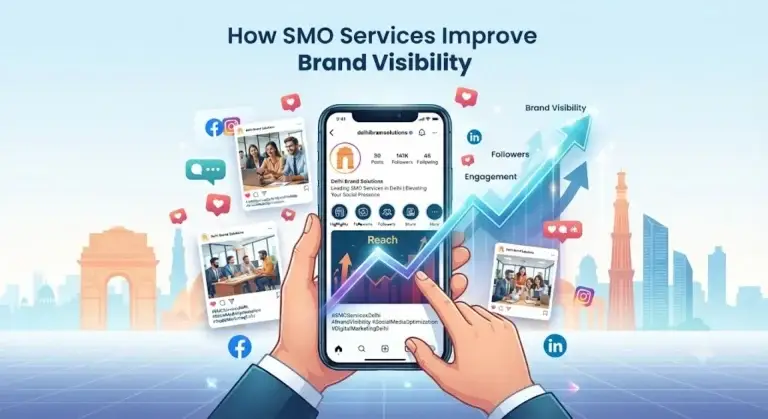
SMO isn’t the same as social media marketing. Marketing is about running campaigns and ads. Optimization is about making the account itself work harder — the profile, the content structure, the timing, the engagement loop — so that organic reach and discoverability go up without paying for every single view.
The social media optimization benefits show up in a few concrete places: how easily a new visitor understands what you sell within three seconds of landing on your profile, how often your posts get pushed into non-follower feeds by the algorithm, and how many of those non-followers convert into follows. None of that happens by accident.
A shocking number of business profiles still have a blurry logo, a bio that reads like a mission statement instead of an offer, and a link that goes nowhere useful. Profile optimization means:
This sounds basic. It’s also the single most-skipped step, because it’s boring compared to making content. But a well-optimized profile converts profile visits into follows at a noticeably higher rate — and every hashtag strategy or content push in the world is wasted if the landing spot doesn’t hold attention.
A brand visibility strategy isn’t “post more.” It’s a decision about which platforms deserve your effort, what content pillars you’ll repeat, and how often you show up in a way people can predict. Visibility compounds when the same account keeps appearing with a recognizable voice — not when it occasionally goes viral and then disappears for three weeks.
Three things drive that compounding effect:
Working with local businesses shows the same pattern repeatedly: strong products, decent content, but almost no location-specific optimization. If your customer base is Delhi-NCR, your bio, your geotags, and even your hashtag mix should reflect that — a mix of city-specific and pan-India tags outperforms either extreme on its own. Local business categories, correct location tagging on posts, and geotag consistency across platforms all feed into how often the platform surfaces you to people actually searching nearby.
This is also where a lot of DIY social media effort quietly plateaus. A founder can write good captions but rarely has the bandwidth to track which hashtag combinations are actually pulling reach week over week, or to A/B test posting times against their specific audience’s activity hours. That tracking-and-adjusting loop is most of what separates a stagnant account from one that’s genuinely growing.
Profile-level fixes (bio, links, highlights) show up immediately in how visitors perceive the account. Reach and follower growth from hashtag and consistency changes typically need 6–8 weeks of steady posting before patterns become clear enough to judge — social algorithms need a run of consistent signals before they adjust distribution.
No — spreading effort thin across five platforms usually produces worse results than doing two platforms properly. Pick where your actual audience spends time and go deep there first.
Hashtags matter less than they did years ago for pure discovery, but they still help with search-based discovery within apps (people typing a term into Instagram or LinkedIn search) and with categorizing content for the algorithm. Treat them as a support tool, not the main lever.
SMO improves how well your organic presence performs — profile, structure, posting habits, engagement. Ads buy reach directly. The two work best together: SMO makes sure the profile ads send people to is actually worth following, and ad data can reveal which content themes to double down on organically.
Not every post, but not never either. A practical rhythm is reviewing which tag sets are pulling reach every 3–4 weeks and rotating out the weaker ones, rather than either freezing the same set forever or randomizing it post to post.
Consistency is about a predictable rhythm, not daily volume. Three fixed days a week that you actually hit every single week builds a stronger signal than daily posting that falls apart after ten days. Pick a frequency you can sustain for months, not one that looks ambitious on paper.
It matters on both, but differently. Instagram profile optimization leans on bio clarity, link-in-bio setup, and highlight covers. LinkedIn leans more on the banner, the About section, and featured posts, since B2B visitors typically read more before deciding to follow or connect.
It can be managed by a team as long as the tone and factual answers stay accurate to the brand — the key is response speed and genuine relevance, not who physically types the reply. What breaks trust is generic, copy-pasted replies that ignore what the comment actually said.
Social visibility and Google SEO are separate systems, so there’s no direct ranking boost from social activity alone. What does happen indirectly is more branded searches, more people linking to your site from bios or posts, and more traffic that can support your broader digital presence.
It shows up mainly in geotagging, local hashtag mixing, and timing posts around when a Delhi-NCR audience is actually active, rather than defaulting to generic best-practice hours. A generic national strategy skips that layer entirely and treats every follower the same regardless of location.
Profile optimization, hashtag strategy, and community engagement aren’t separate tactics running in isolation — they’re pieces of one system, which is exactly what our SMO Services page covers in full, from initial audit to ongoing management.
Want your profile and posting strategy audited properly instead of guessed at? Reach out to Ritwik Sachdeva at 9289626386 or visit ritwiksachdeva.in to get a Delhi-focused SMO plan built around your actual audience — not a generic checklist.