Why Purpose-Led Branding in India Is Winning Consumer Trust in 2026
Why Purpose-Led Branding in India Is Winning Consumer Trust in 2026 Purpose-led branding in India is winning trust because Indian...
Read More → 
THE BEST MARKETING CONSULTANT IN DELHI
Social Media Optimization (SMO) is the process of building your brand’s visibility, engagement, and credibility on social platforms — Instagram, Facebook, LinkedIn, X — so that people discover, trust, and interact with your business without needing to search for it first. SEO, on the other hand, works through search engines like Google, ranking your website so people find it when they’re actively looking for something. The two aim at the same outcome — more eyes on your brand — but they use completely different paths to get there.
If you’ve been comparing smo vs seo and wondering which one your business actually needs, the honest answer is: probably both, just not for the same job.
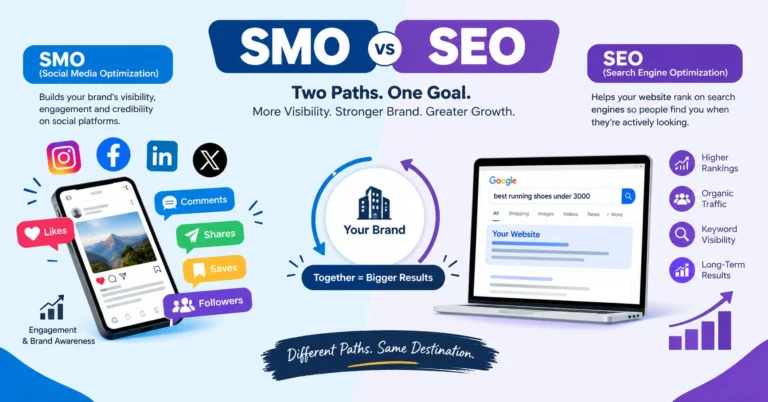
SEO is built around intent. Someone types “best running shoes under 3000” into Google because they already know what they want — SEO’s job is to make sure your page shows up at that exact moment. It’s pull-based. The user pulls you into their world.
SMO works the opposite way. Nobody wakes up searching for your brand on Instagram. Instead, your content shows up in their feed, catches their attention through a reel, a carousel, or a comment thread, and pulls them toward you. It’s push-based — you’re inserting your brand into a moment where the person wasn’t necessarily looking for anything.
This is why the two get measured so differently. SEO success looks like rankings, organic traffic, and keyword positions. SMO success looks like social signals — shares, saves, comments, DMs — plus brand visibility and organic social reach that compounds over time as more people see and pass along your content.
SMO isn’t just “posting on social media.” It covers a specific set of activities:
Here’s the part most explanations skip: social signals don’t directly move your Google rankings the way a backlink does. But indirectly, a strong SMO presence does real work for SEO. Content that gets shared widely on social often gets discovered, linked, and cited by other websites — and that’s the kind of backlink signal Google does care about. Branded search (people typing your business name into Google after seeing you on Instagram) also tells search engines your brand is a real, trusted entity, not just another page competing on keywords.
So the relationship isn’t “SMO replaces SEO” or “SEO makes SMO unnecessary.” It’s closer to: SEO captures demand that already exists, SMO creates demand and awareness that eventually turns into search demand.
It depends on where your business is:
A mistake seen often: treating every platform identically, posting the same graphic with the same caption everywhere, and then wondering why engagement is flat. Another common one is chasing follower count while ignoring engagement rate — a smaller, engaged audience that comments and shares is worth more than a large, silent one, both for social proof and for the indirect SEO benefit mentioned above.
A third mistake is disconnecting SMO from the actual sales funnel. Social content that gets likes but never links back to a product page, a landing page, or a clear next step is just noise — it needs to feed the business, not just the feed.
Not quite. SMM usually includes paid social ads and campaign-driven promotion. SMO is more about organic optimization — profile setup, content strategy, engagement — that makes your social presence work harder without ad spend.
Not directly as a ranking factor, but indirectly yes — through increased backlinks, branded searches, and content discovery that search engines do track.
Yes, if you’re building a brand rather than just running a single campaign. Ads bring one-time traffic; SMO builds the kind of ongoing brand recall that reduces your dependency on ad spend over time.
Similar to SEO, it’s not instant. Engagement metrics can shift within weeks, but meaningful organic social reach and brand visibility typically build over a few months of consistent, platform-specific content.
Social signals are the shares, likes, comments, and saves your content collects. They matter less as a direct ranking input and more as a trust indicator — content that gets widely shared tends to get discovered, linked to, and cited elsewhere, which is the part search engines do factor in.
It depends on where the target audience actually spends time. Visually-driven products tend to do better on Instagram; B2B or higher-ticket products often see more traction on LinkedIn. Spreading effort thin across every platform usually performs worse than doing two platforms properly.
Yes — SMO is largely about strategy and consistency, not ad spend. A business posting sporadically with no plan will lose to a smaller competitor posting less often but with sharper, platform-specific content and faster engagement response.
Follower count is a vanity number; engagement rate (comments, shares, saves relative to reach) reflects whether people actually care about what you’re posting. A smaller, engaged audience converts better and signals more authentic brand visibility than a large, inactive one.
Local businesses benefit from geo-tagged content, location-based hashtags, and engaging with local community pages or accounts, alongside the standard SMO fundamentals — since a chunk of the audience discovering the brand is searching or scrolling with local intent.
Start by auditing and fixing the profile itself — bio, keywords, consistent handle, and a clear link back to the website — before worrying about content volume. A polished profile converts the traffic that’s already arriving; posting more before that is fixed just wastes the effort.
If you’re running an ecommerce brand and trying to figure out whether you need SMO, SEO, or both working together, that’s exactly the kind of setup SMO Services is built to handle — profile optimization, content strategy, and engagement management tailored to how your specific audience actually behaves on each platform.
Reach out to Ritwik Sachdeva at ritwiksachdeva.in or call 9289626386 to talk through where your brand currently stands and what would move the needle first.