Why Purpose-Led Branding in India Is Winning Consumer Trust in 2026
Why Purpose-Led Branding in India Is Winning Consumer Trust in 2026 Purpose-led branding in India is winning trust because Indian...
Read More → 
THE BEST MARKETING CONSULTANT IN DELHI
If you’re running a business in Delhi and have to pick one platform to start with, the honest answer is: it depends on what stage your buyer is at. Google Ads wins when someone is already searching for what you sell — a plumber, a CA, a gym membership near Lajpat Nagar. Meta Ads (Facebook and Instagram) wins when nobody’s searching yet, but you can put your offer in front of the right person while they’re scrolling. Most Delhi businesses that actually see strong ROI aren’t choosing one over the other forever — they’re using Google Ads to catch demand and Meta Ads to create it, then adjusting the split as they learn what converts.
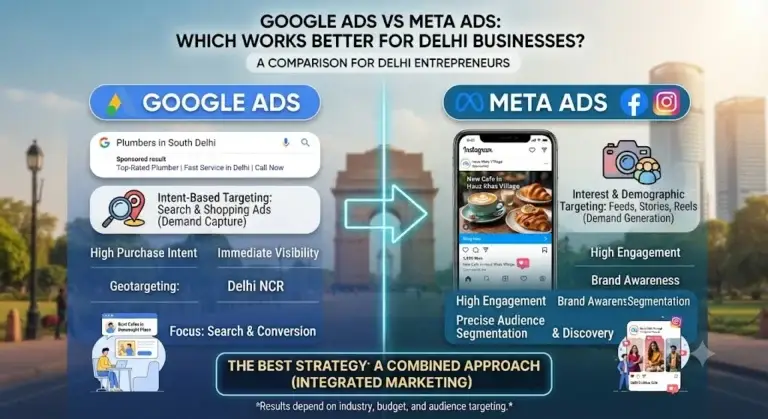
Delhi and NCR businesses tend to serve a mix of hyper-local footfall (a market in Karol Bagh, a clinic in Dwarka) and digital-first buyers who compare five options before calling anyone. That mix is exactly why the Google vs Meta question doesn’t have one clean answer — the two platforms are solving different problems.
Google Ads shows your ad when someone types an actual query — “best dentist in Rohini,” “packers and movers Gurgaon,” “buy running shoes online India.” The person is already looking for a solution. Your job is just to be the answer that shows up.
Where it works best for Delhi businesses:
Where it struggles:
Cost per click on Google Ads in competitive Delhi categories — legal services, real estate, coaching institutes — tends to run higher than Meta CPCs, simply because more advertisers are bidding on the same commercial-intent keywords. That’s the trade-off: you’re paying more per click, but the person clicking already wants what you’re selling.
Meta doesn’t wait for someone to search. It shows your ad based on who they are, what they’ve engaged with, and what Meta predicts they’ll respond to — age, location, interests, past behaviour on Instagram and Facebook. You’re not answering a question; you’re interrupting a scroll with something worth stopping for.
Where it works best for Delhi businesses:
Where it struggles:
Meta’s cost per click is usually lower than Google’s in most Delhi categories, but that number alone is misleading. A cheap click from someone who wasn’t looking to buy is worth less than a costlier click from someone who was already searching.
The simplest way to think about it: Google Ads meets demand, Meta Ads creates demand. If you sell something people already search for by name or category, Google should usually get first budget priority. If you sell something people don’t know they need until they see it, Meta does the heavier lifting.
For a lot of Delhi businesses, the real split looks like this in practice:
Comparing raw CPC numbers between the two platforms isn’t that useful on its own — a ₹15 Meta click and a ₹60 Google click aren’t the same kind of click. What actually matters for a Delhi business deciding where to put money is cost per lead or cost per sale, not cost per click. A service business getting fewer, higher-intent clicks from Google can end up with a lower true cost per customer than one getting a flood of cheap Meta clicks that don’t convert.
If budget is tight, the smarter move is usually a small test on both — split evenly for two to three weeks — and then double down on whichever channel is actually producing leads or sales at a cost you can live with, not just clicks.
None of this is a permanent decision. The right split changes as your business grows, as competitors move in and out of the auction, and as your own data tells you where your actual customers are coming from. That’s the part a lot of businesses skip — checking the numbers monthly instead of setting a budget once and forgetting it.
If you want a structured breakdown of how to plan and run paid ads across platforms for a Delhi-based business, our PPC Expert guide covers the strategy in more depth.
Meta Ads usually has a lower cost per click, but Google Ads often has a lower cost per actual sale for products people already search for, because the person clicking has higher intent. Compare cost per lead, not cost per click.
Yes, and for most local businesses it’s the better approach — Google captures people actively searching, while Meta builds awareness and retargets people who’ve already shown interest but haven’t bought yet.
Meta Ads tends to work well for footfall because of radius targeting and visual content, while Google Ads (especially local search and Maps ads) catches people searching “near me” right when they’re ready to visit.
No. Both platforms let you start small and scale based on what’s actually converting. The mistake most businesses make isn’t starting too small — it’s not reviewing performance often enough to shift budget toward what’s working.
Give a campaign at least two to three weeks of real data before judging it — enough time for the algorithm to optimise and for you to see patterns beyond random daily fluctuation.
Google Ads usually wins for B2B because buyers actively search for solutions using specific terms — “GST filing consultant Delhi,” “industrial packaging supplier NCR.” Meta can still help with retargeting decision-makers who visited your site but didn’t fill out an enquiry form.
You can, but splitting a very small budget across both often means neither gets enough data to optimise properly. If funds are tight, it’s usually better to run one platform properly for a few weeks, then add the second once you have some conversion data to guide the split.
It can, but it needs a different approach than a product photo — think educational content, client outcomes stated honestly, or a clear explainer that builds trust before asking for a call. Without that, professional-service ads tend to get scrolled past.
Usually it’s more advertisers bidding on the same keywords, a drop in your ad’s quality score, or a seasonal spike in demand (coaching institutes before exam season, real estate around festive periods). Checking the auction insights report usually shows which of these is happening.
If people are already searching for what you offer, start with Google Ads since intent-based traffic tends to convert faster even with no brand history. If your product is new to the market and nobody’s searching for it by name yet, Meta Ads is usually the better starting point to build initial awareness.
Need help setting up or auditing your Google Ads and Meta Ads campaigns? Reach out to Ritwik Sachdeva at 9289626386 or visit ritwiksachdeva.in to get started.