Why Purpose-Led Branding in India Is Winning Consumer Trust in 2026
Why Purpose-Led Branding in India Is Winning Consumer Trust in 2026 Purpose-led branding in India is winning trust because Indian...
Read More → 
THE BEST MARKETING CONSULTANT IN DELHI
PPC Expert in Delhi hiring requires looking at three things: a verifiable case history, a campaign strategy built around your actual numbers (not industry averages), and complete transparency on spend and results. Certifications matter less than most agencies want you to believe — they show someone passed a test, not that they can manage your ad budget without wasting it.
Delhi’s ad market is crowded and expensive. CPCs in competitive categories like real estate, education, and legal services can run several times higher here than in tier-2 cities, which means a mediocre PPC specialist doesn’t just underperform — they actively burn cash faster than in most other markets. That’s the real reason this decision deserves more scrutiny than a quick Google search and a call with whoever answers first.
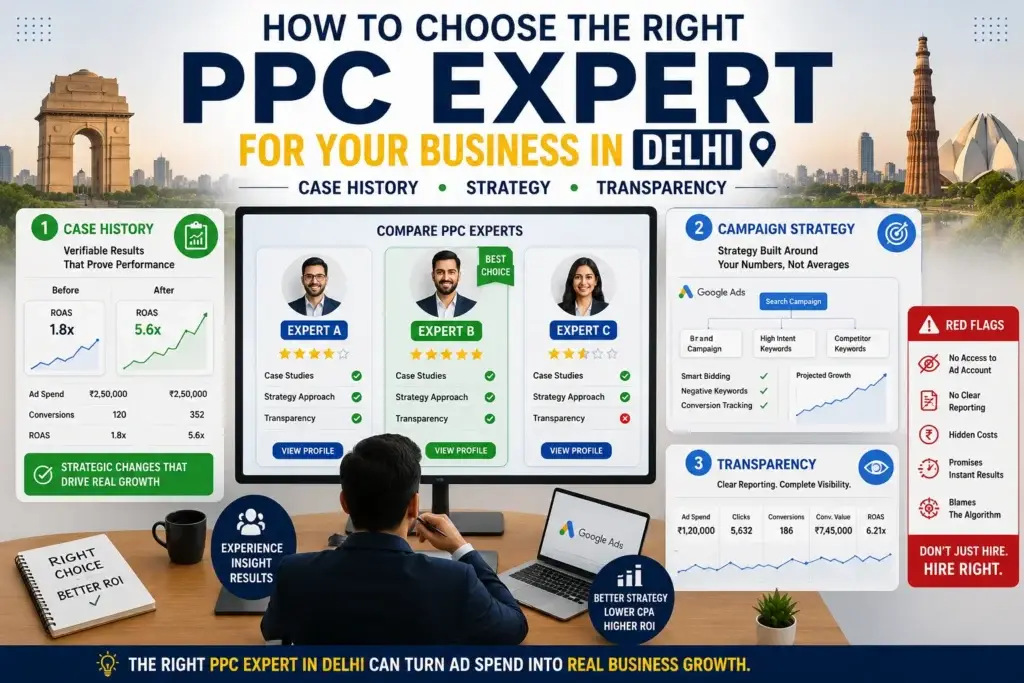
Google Ads certification, Google Partner status, Meta Blueprint badges — these are worth checking, but only as a baseline filter, not a selection criterion. Here’s why: certifications test knowledge of the platform’s interface and rules. They don’t test judgment, and judgment is what separates a PPC specialist who scales a campaign profitably from one who just spends your budget competently.
What actually tells you more:
If a hire a PPC specialist conversation starts and ends with “we’re Google certified,” that’s a sign to keep looking, not a reason to sign.
Most businesses ask “do you have case studies?” and stop there. That’s not enough. Ask instead:
If someone can’t walk you through at least one campaign in enough detail that you understand what they actually did — not just what it achieved — treat that as a gap, not an oversight.
A generic PPC pitch talks about “driving traffic” and “maximizing visibility.” A real strategy conversation talks about your business specifically:
Ask any prospective hire to sketch a rough plan for your specific business, on the spot, in the meeting. Their ability to think through it live tells you more than any prepared pitch deck.
This is where most bad hires reveal themselves, usually within the first month. Watch for:
A few patterns show up repeatedly:
Pricing varies by scope — a freelance specialist managing a single, focused account will usually charge differently than a full-service agency running Search, Shopping, and Display together. Ask for a breakdown of management fee versus expected ad spend before comparing quotes across providers.
It depends on how hands-on you want the relationship to be. A freelancer often means direct access to the person actually running your account; an agency can offer more bandwidth and cross-channel coordination but sometimes adds a layer between you and the day-to-day work. Neither is automatically better — match it to how much oversight you want.
Most accounts need a few weeks of data collection before performance stabilizes, especially for new accounts with no prior conversion history. Anyone promising strong results within days is either working with an unusually mature account or setting expectations that won’t hold up.
Ask about their process for the first 30 days, how they structure reporting, whether you’ll retain account ownership, and to walk you through one past campaign in real detail. Their answers will tell you more than any credentials list.
It’s useful as a basic filter but not a deciding factor. Certification confirms someone understands the platform’s mechanics — it doesn’t confirm they can read your account data and make the right call when a campaign underperforms. Weigh it alongside case history and strategy conversations, not on its own.
A PPC expert typically specializes in paid search and paid social management specifically — account structure, bidding, keyword strategy — while a general digital marketing agency often spreads focus across SEO, social media, content, and ads together. If paid ads are your main priority right now, a specialist usually means deeper, more focused attention on that one channel.
Yes, as long as the Google Ads account stays under your ownership from the start. This is exactly why confirming account ownership terms upfront matters — if the account was created and owned by the previous specialist, you can lose historical conversion data and audience signals when you switch.
There’s no fixed industry minimum, but very small budgets limit how much data a campaign can generate, which makes optimization slower. A good specialist will tell you honestly if your budget is too thin to test properly, rather than taking it on and promising results anyway.
Watch for reluctance to give you admin access to your own ad account, reports that show only summarized metrics instead of raw numbers, invoices that don’t separate ad spend from management fees, and vague explanations whenever a campaign underperforms.
Reporting frequency should match how actively the account is being managed — weekly check-ins are common during the first month while campaigns are still being tuned, with monthly deep-dive reports once performance stabilizes. Ask upfront what their standard reporting cadence looks like and whether you can request raw data anytime, not just on their schedule.
Choosing the right PPC expert in Delhi comes down to checking real work, not just claims — and working with someone who’s upfront about what a campaign can realistically do for your specific business. For a deeper breakdown of what the role actually involves day to day, see our full guide on hiring a PPC expert.
If you’d rather skip the vetting process, Ritwik Sachdeva works directly with Delhi businesses on Google Ads strategy, account audits, and ongoing campaign management — with full transparency on spend and reporting from day one. Reach out at ritwiksachdeva.in or call 9289626386 to talk through your account before you commit to anyone.