Why Purpose-Led Branding in India Is Winning Consumer Trust in 2026
Why Purpose-Led Branding in India Is Winning Consumer Trust in 2026 Purpose-led branding in India is winning trust because Indian...
Read More → 
THE BEST MARKETING CONSULTANT IN DELHI
Common Performance Marketing Mistakes are one of the biggest reasons ad spend gets wasted. Most wasted ad spend doesn’t come from a bad platform or a stingy algorithm — it comes from performance marketing mistakes that show up early in a campaign and just never get caught. A brand pours money into Meta or Google Ads, sees some clicks, some sales, maybe even a decent ROAS number for a week or two, and assumes things are working. Then the numbers quietly slide, and nobody can say exactly why. That “why” is almost always one of a handful of recurring errors, not some mysterious market shift.
If you’re running ads for an ecommerce brand — or paying someone else to run them — these are the mistakes that eat budget the fastest, and what actually fixes each one.
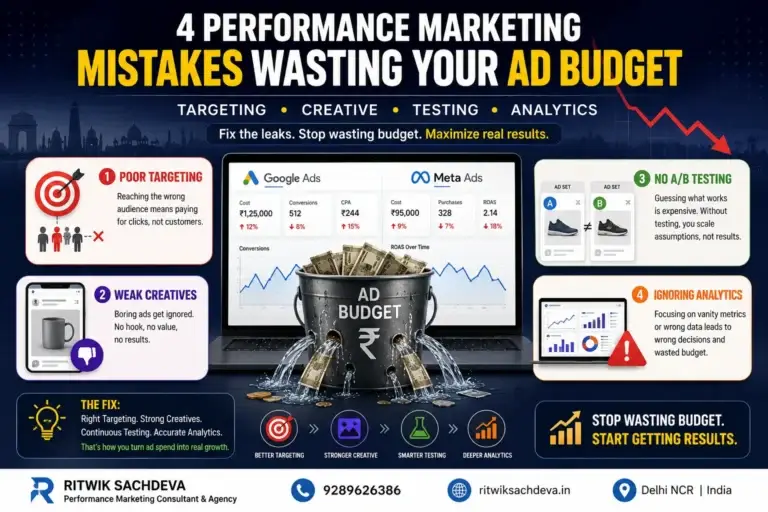
The single biggest driver of wasted ad spend is targeting that’s too broad, too narrow, or simply aimed at the wrong signal. Broad targeting feels efficient on paper — bigger audience, more impressions, lower CPM — but if half that audience has zero purchase intent, you’re paying to educate people who were never going to convert.
The opposite problem is just as common: audiences squeezed so tight (hyper-specific interest stacks, narrow lookalikes, over-layered exclusions) that the algorithm runs out of people to show ads to and starts serving them to whoever’s left, intent or not.
What actually works is building targeting around buying signals, not demographics. Purchase history, cart behavior, site engagement depth, and lookalike audiences built from actual customers (not just page-likes or video-viewers) consistently outperform interest-based targeting alone. And targeting isn’t a “set once” decision — audiences fatigue, and a segment that converted well in month one can be dead weight by month three if nobody’s watching.
A campaign can have perfect targeting and still burn budget if the creative doesn’t give anyone a reason to stop scrolling. This is where a lot of ad spend quietly disappears — not because the audience was wrong, but because the ad itself was forgettable.
Common creative mistakes:
Creative refresh needs to be treated as an ongoing part of the campaign, not a one-time asset delivery. Rotating angles — problem-first, testimonial-style, comparison, demonstration — keeps the algorithm (and the audience) from going numb to the same message.
A lot of budget gets wasted simply because nobody’s testing — they’re guessing, then sticking with the guess. Running one ad set, one creative, one offer, and calling it a strategy means every rupee spent is riding on a hunch instead of data.
Proper testing isn’t complicated, but it does need discipline:
Without structured testing, “campaign optimization” usually just means turning off whatever looks worst today — which isn’t optimization, it’s reaction.
This is the mistake that makes every other mistake worse, because it’s the one that hides the problem. A lot of accounts get optimized around vanity metrics — impressions, clicks, even ROAS in isolation — while the number that actually matters, like true customer acquisition cost after discounts and returns, sits unexamined.
A few specific analytics blind spots show up constantly:
The fix isn’t more data — most accounts already have plenty. It’s building a habit of actually looking at the numbers that reflect real business outcomes, on a schedule tight enough to catch a problem before it costs real money.
None of these four mistakes exist in isolation. Poor targeting makes weak creative look worse than it is. Skipping A/B testing means poor targeting never gets caught. Ignoring analytics means nobody notices any of it until the budget’s already gone. Fixing one without the others tends to produce short-lived improvement — the real gain comes from treating targeting, creative, testing, and analytics as one connected process that gets checked and adjusted together, not four separate boxes to tick once at launch.
It varies by account, but poorly optimized campaigns commonly waste a significant share of spend on audiences or creatives that were never going to convert. The real number depends on account maturity, industry, and how often the campaign is actually reviewed.
As a general rule, watch frequency and performance rather than the calendar — once an ad’s frequency climbs and click-through rate starts dropping, it’s time to rotate in a new angle, regardless of how long it’s been running.
Not on its own. A low CPM with a broad, low-intent audience can still produce a higher real cost per sale than a higher CPM aimed at a tighter, high-intent audience. CPM needs to be read alongside conversion rate and true CAC, not by itself.
Yes — in most cases, fixing targeting, creative rotation, testing discipline, and analytics tracking improves results from the same spend rather than requiring more of it. These are efficiency problems, not budget-size problems.
Watch the ratio between reach and conversion rate over the same period. If reach is climbing but conversion rate is falling, the audience is probably too broad. If the algorithm keeps showing “limited audience” warnings or costs are spiking with flat reach, it’s too narrow. Either way, the fix is going back to purchase and engagement signals rather than guessing at demographics.
There’s no single magic number, but a test needs enough conversions per variant — not just clicks — for the result to mean anything. Ending a test on raw impressions or a handful of sales usually just measures noise, not a real winner.
Attribution windows, view-through counts, and cross-device tracking all inflate what a platform reports compared to verified orders in your store backend. This gap is normal to some degree, but a large or growing one usually means the campaign is being credited for sales it didn’t actually drive.
It depends on whether the dip is a genuine trend or normal day-to-day variance. A single bad day rarely justifies a pause; a consistent multi-day decline in the metrics tied to real business outcomes (not just clicks) usually does.
Not automatically, but it does mean you’re leaving a variable untested. Different audiences often respond differently to a discount code versus free shipping versus a bundle — treating the offer itself as fixed removes one of the biggest levers available for improving conversion rate.
Usually when internal teams don’t have the bandwidth to run structured testing and daily analytics review alongside everything else on their plate — that ongoing attention is where a dedicated Performance Marketing Consultant & Agency tends to make the most visible difference, since consistent monitoring is exactly what most in-house setups skip.
If any of the mistakes above sound familiar in your own account, the fastest way to find out how much they’re actually costing you is a straightforward audit — targeting, creative performance, testing history, and what your analytics are actually saying versus what the dashboards show at a glance.
Ritwik Sachdeva works with ecommerce brands on exactly this kind of performance marketing cleanup and ongoing management. You can reach out at 9289626386 or through ritwiksachdeva.in to get your current campaigns looked at.