Why Purpose-Led Branding in India Is Winning Consumer Trust in 2026
Why Purpose-Led Branding in India Is Winning Consumer Trust in 2026 Purpose-led branding in India is winning trust because Indian...
Read More → 
THE BEST MARKETING CONSULTANT IN DELHI
If you’re spending money on ads and can’t say exactly what it returned last month, you don’t have a marketing problem — you have a tracking problem. A performance marketing agency in Delhi earns its fee by tying every rupee spent to a rupee (or more) earned back, using conversion tracking, attribution models, and a running read on CAC versus LTV. Here’s how that actually works, not just in theory but in the tools and decisions that make it real.
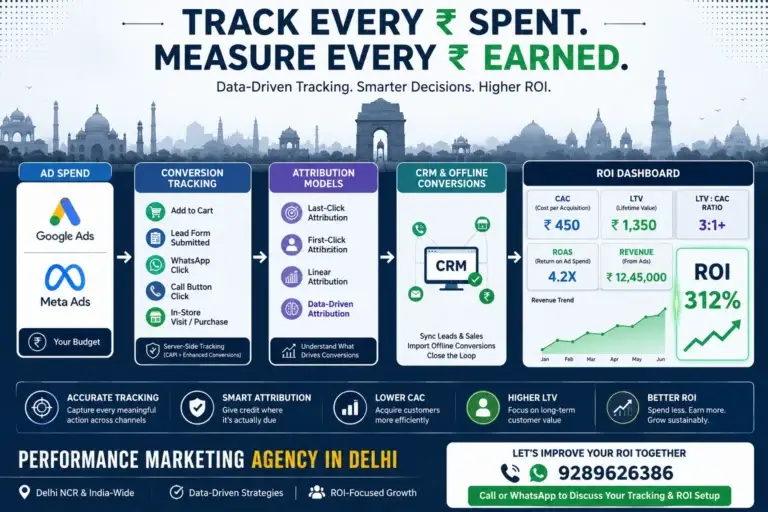
Most local businesses run ads on two or three platforms — Meta, Google, maybe an influencer push — and check results in three separate dashboards that never agree with each other. Meta says one number of conversions, Google Ads says another, and the actual sales register or CRM says a third. None of them are lying; they’re just measuring different things, at different points in the funnel, with different attribution windows.
A performance marketing agency’s first job isn’t running ads. It’s building a single source of truth that all three can be checked against.
Before ROI can mean anything, every meaningful action a user takes has to be captured — not just “purchase,” but the steps before it: add to cart, checkout started, lead form submitted, WhatsApp click, call button tap. For a Delhi business selling to a local or India-wide audience, this usually means:
Skip this step and every ROI number that follows is built on sand.
Here’s where a lot of confusion happens. If someone sees an Instagram ad, searches your brand on Google two days later, and buys — which channel gets credit for that sale?
Different models answer this differently:
For a Delhi business running both awareness (reels, influencer content) and intent-based campaigns (Google Search, retargeting), a good agency won’t rely on one model blindly — they’ll pull multi-touch reports and cross-check what last-click is hiding, especially for longer B2B or high-ticket sales cycles.
Cost per lead or cost per click are vanity numbers if they’re not connected to what a customer is actually worth.
Customer Acquisition Cost (CAC) is total spend divided by new customers acquired in a period — but the useful version breaks this down by channel, campaign, and even creative, so you know Meta prospecting is bringing customers in at ₹450 while Google Search brings them in at ₹280.
Lifetime Value (LTV) is what a customer is worth across their full relationship with the business — not just the first order. A Delhi D2C brand with a ₹1,200 average order value but 40% repeat purchase rate within 90 days has a very different acceptable CAC than a one-time-service business.
The ratio that actually matters is LTV : CAC. A rule of thumb agencies track toward is roughly 3:1 or higher — spend less than a third of what a customer is worth to acquire them, or the growth isn’t sustainable no matter how good the top-line revenue number looks.
In practice, ROI tracking isn’t a one-time setup — it’s a live loop:
It’s harder but not impossible — for straightforward ecommerce, platform-level conversion tracking plus GA4 can cover most of it. Once leads go through a sales call or offline close, though, a CRM (even a simple one) becomes necessary to close the loop between ad spend and actual revenue.
Each platform tends to take credit for conversions within its own attribution window, so overlapping touchpoints get double-counted across platforms. This is normal — it’s why agencies rely on a separate source of truth (GA4, CRM, or a data warehouse) rather than trusting either platform’s dashboard in isolation.
CAC by channel is worth checking weekly during active campaigns. LTV moves slower and is usually reviewed monthly or quarterly, since it depends on repeat purchase behavior that takes time to show up.
Generally yes for accounts with enough conversion volume for the model to learn from, but it needs a reasonable amount of data to work well — very low-volume accounts may still get more stable reads from a simpler model.
Without repeat-purchase history, agencies usually work off industry benchmarks for the category first, then correct the CAC ceiling once 60–90 days of real repeat-purchase data comes in. Treating the first quarter’s ratio as final is a common mistake — it’s a starting estimate, not the settled number.
It affects any business advertising to iPhone users, regardless of where the business is based — Apple’s tracking restrictions apply at the device level, not the region level. This is exactly why server-side tracking (Conversions API, Enhanced Conversions) matters even for a purely India-focused campaign.
Yes, but it needs offline conversion tracking set up deliberately — call tracking numbers, WhatsApp click events, and a way to feed the eventual sale (or non-sale) back into the ad platform. Without this loop, the platform only ever sees the click, never whether it actually turned into revenue.
There’s no single universal number, but most platforms’ data-driven models need a steady, meaningful flow of conversions per month before the model has enough signal to weight touchpoints accurately. Below that, reports still work — they’re just noisier and shouldn’t be over-read week to week.
ROAS (return on ad spend) only accounts for ad cost against revenue from ads; true ROI factors in the full cost of running the campaign — creative production, agency fees, discounts given, and returns/refunds. A campaign can show a strong ROAS and still be unprofitable once the full cost picture is included.
Yes, but it requires consistent UTM and naming conventions across every account from day one, plus a central reporting layer (GA4, a data warehouse, or a reporting tool) that pulls all accounts together — otherwise each account’s numbers stay siloed and can’t be compared fairly.
Agar aap performance marketing consultant dhoondh rahe hain jo Delhi businesses ke liye ye poora tracking-se-ROI loop actually set up aur manage karta hai — Performance Marketing Consultant & Agency se baat karein. Call ya WhatsApp kar sakte hain 9289626386 par, seedha apni current tracking setup discuss karne ke liye.