
Ecommerce Management vs Ecommerce Marketing: What's the Difference
If your online store has plenty of traffic but orders still feel unpredictable, or your ad campaigns look great on paper but returns keep eating your margin, you’re probably mixing up two very different jobs: ecommerce management and ecommerce marketing. The short answer — ecommerce management runs the backend operations that keep your store functioning (inventory, fulfillment, listings, platform health), while ecommerce marketing focuses on demand generation, getting people to notice and buy from you. One keeps the engine running. The other puts fuel in the tank. Most stores need both, but they are not interchangeable, and treating them as the same thing is where a lot of sellers lose money without realizing why.
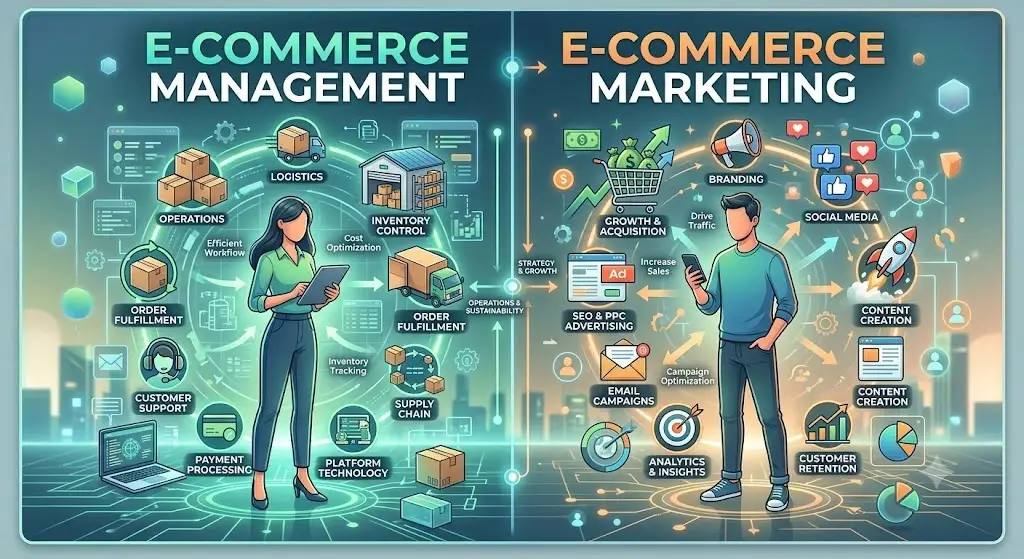
What Ecommerce Management Actually Covers
Ecommerce management is the operational backbone of your store. It’s everything that happens after someone decides to buy, and a lot of what happens before that decision is even possible.
This includes:
- Inventory and stock management — making sure products are in stock across every channel, avoiding overselling, and syncing warehouse data with what’s shown online
- Order processing and fulfillment — from the moment an order is placed to the moment it’s packed, shipped, and delivered
- Listing management — accurate titles, descriptions, images, and pricing kept consistent across marketplaces and your own website
- Platform and account health — resolving account issues, staying compliant with marketplace policies (Amazon, Flipkart, Shopify, etc.), and fixing errors before they turn into suspensions
- Returns and customer service operations — handling refunds, replacements, and support tickets in a way that doesn’t drain your time
- Reporting and data hygiene — keeping sales, inventory, and performance data clean enough to actually make decisions from
None of this is glamorous. It doesn’t show up in a pitch deck the way a viral ad campaign does. But if your fulfillment is late, your stock counts are wrong, or your account gets flagged for a policy violation, no amount of marketing spend fixes that. Bad operations quietly cap how much a business can grow, even when demand exists.
What Ecommerce Marketing Actually Covers
Ecommerce marketing is demand generation — the work of getting the right people to discover, consider, and buy your products. It’s outward-facing, built around visibility and conversion.
This includes:
- Paid advertising — Google Ads, Meta Ads, marketplace sponsored listings
- SEO and content — product page optimization, blog content, keyword targeting
- Social media and influencer activity — building brand presence and reach
- Email and retention marketing — abandoned cart flows, re-engagement campaigns, loyalty offers
- Conversion rate optimization (CRO) — testing pricing, page layout, and messaging to turn visitors into buyers
- Brand positioning and growth strategy — figuring out who you’re selling to and why they should pick you over a competitor
Marketing is what creates the spike in orders. It’s also the part most sellers instinctively invest in first, because the results (traffic, clicks, sales numbers) are visible almost immediately. The problem is that a spike in orders with weak operations behind it usually turns into delayed shipments, stockouts, and bad reviews — which then makes the next marketing campaign work harder for less.
The Core Difference, in One Line
Ecommerce management is about fulfillment and operational stability — can you reliably deliver on what you sell. Ecommerce marketing is about promotion and demand — can you get people to want to buy in the first place. One protects the business from breaking under its own growth. The other creates the growth.
Ecommerce Management | Ecommerce Marketing | |
Focus | Backend operations | Demand generation |
Core question | Can we fulfill and sustain orders? | Can we attract and convert buyers? |
Typical tasks | Inventory, listings, fulfillment, account health | Ads, SEO, content, CRO, retention |
When it fails | Late shipping, stockouts, account suspensions | Low traffic, poor visibility, weak conversion |
Visible impact | Slow, structural — you feel it when it’s missing | Fast, immediate — spikes in traffic and sales |
Why Sellers Often Confuse the Two
A lot of sellers hire an “ecommerce agency” and assume it covers everything end to end. In reality, most agencies specialize in one side. A marketing-focused agency will run ads and optimize your listings for clicks, but won’t touch your inventory sync or handle a marketplace account warning. An operations-focused service will keep your store running smoothly but won’t build you a customer acquisition strategy.
This gap becomes obvious during high-demand periods — festive sales, flash sales, a viral product moment. Orders come in faster than the backend can process, stock runs out mid-campaign, or a shipping delay turns a good ad campaign into a wave of refund requests. The marketing worked. The management didn’t keep up. Both sides need to move together, or growth becomes self-defeating.
Which One Does Your Store Need First?
If your store already gets decent traffic but you’re struggling with delayed orders, inventory mismatches, marketplace warnings, or messy reporting — that’s a management problem, and fixing marketing first won’t help. If your operations are solid but you’re not getting enough visibility or your ad spend isn’t converting — that’s a marketing problem.
Most growing sellers eventually need both, run in coordination rather than as separate, disconnected efforts. Operations that can scale with demand, paired with marketing that doesn’t outpace what the backend can actually deliver.
How Ritwik Sachdeva Approaches This
At E-Commerce Management Services, the focus is on getting the operational side right — inventory accuracy, order fulfillment, listing management, and account health across marketplaces — so that whatever marketing effort you’re putting in (or plan to put in) actually converts into orders that get delivered on time. If your store has been struggling with the operational side while sales conversations keep circling back to marketing, that’s usually a sign the backend needs attention first.
To get a clear picture of where your store’s operations currently stand, reach out at 9289626386 or visit ritwiksachdeva.in — a quick conversation is often enough to spot where the gaps are.
FAQs
Is ecommerce management the same as ecommerce marketing?
No. Management covers backend operations like inventory, fulfillment, and listings. Marketing covers demand generation like ads, SEO, and content. They work together but solve different problems.
Can I do ecommerce marketing without proper ecommerce management in place?
You can, but it’s risky. Strong marketing without solid operations often leads to stockouts, delayed shipping, and poor reviews during high-demand periods, which can hurt your store’s reputation and marketplace ranking.
Which should a new ecommerce seller prioritize first?
Generally, get your operations stable first — accurate inventory, working fulfillment, clean listings — before scaling marketing spend. Otherwise, you risk generating demand you can’t fulfill properly.
Does ecommerce management include customer service?
Yes, in most cases it includes returns handling, refund processing, and support ticket resolution, since these are tied directly to order fulfillment and operational workflows.
Is SEO part of ecommerce management or ecommerce marketing?
SEO falls under ecommerce marketing since it’s focused on visibility and attracting traffic. However, listing optimization (titles, descriptions, backend keywords on a marketplace) can overlap with management tasks.
What happens if ecommerce operations are neglected during a big sale event?
You typically see overselling, stock mismatches between channels, delayed dispatch, and a spike in customer complaints — even if the marketing campaign driving the sale performed well.
Do marketplaces like Amazon and Flipkart require dedicated management support?
Yes. Each marketplace has its own compliance rules, listing formats, and account health metrics. Poor management here can lead to listing suppression or account warnings, regardless of how good your marketing is.
Can one agency or service handle both ecommerce management and marketing?
Some can, but many specialize in one side. It’s worth clarifying upfront whether a service covers backend operations, demand generation, or both, so there’s no gap between what’s promised and what’s delivered.
How do I know if my store's problem is operational or a marketing issue?
If you have traffic and interest but struggle with fulfillment, stock, or account issues, it’s operational. If your store runs smoothly but isn’t getting enough visibility or conversions, it’s a marketing issue
Does better ecommerce management actually improve marketing results?
Indirectly, yes. Reliable stock, fast fulfillment, and clean listings improve customer reviews and marketplace ranking algorithms, which in turn make marketing efforts more effective and cost-efficient.