
How Ecommerce Management Services Help Online Stores Grow in Delhi
Running an online store sounds simple until you’re the one doing it — updating stock across three marketplaces at midnight, replying to a customer’s “where is my order” message while another one asks for a refund, and realizing you haven’t looked at your ad spend in two weeks. This is where a dedicated ecommerce management partner changes the math for Delhi-based sellers.
Ecommerce management services are the outsourced (or in-house-support) team that runs the operational side of your online store — order processing, inventory syncing across channels, marketplace account management, and customer support — so you can focus on product, sourcing, and growth instead of getting buried in daily admin.
Why Delhi Sellers Specifically Need This
Delhi’s ecommerce scene is unusually crowded and unusually fast. You’ve got sellers running stores on Amazon, Flipkart, Meesho, and their own Shopify or WooCommerce site simultaneously, often shipping from the same NCR warehouse or a rented space in Karol Bagh or Okhla. The volume is there, but so is the chaos — courier delays during Delhi’s winter fog season, GST invoicing across multiple marketplaces, and customers who expect same-day replies on WhatsApp. An ecommerce management consultant who actually understands this local operating environment (not just generic “ecommerce best practices”) makes a measurable difference in how smoothly the business runs.
What Falls Apart Without Proper Management
A few patterns show up again and again with growing Delhi stores:
- Overselling — a product sells out on Amazon but still shows “in stock” on the website, leading to cancellations and a dented seller rating.
- Slow response times — a customer support inbox with a 40-hour reply time, which on Flipkart or Amazon directly hurts your account health score.
- Marketplace suspensions — missed compliance deadlines, incorrect return policies, or unanswered buyer-seller messages that trigger a warning or worse, an account hold.
- No one owns the numbers — nobody’s tracking which SKUs are actually profitable after marketplace commissions, shipping, and returns.
None of these are “someday” problems. They usually start small and compound every month the store keeps growing without a system underneath it.
Core Services That Make the Difference
Order Management
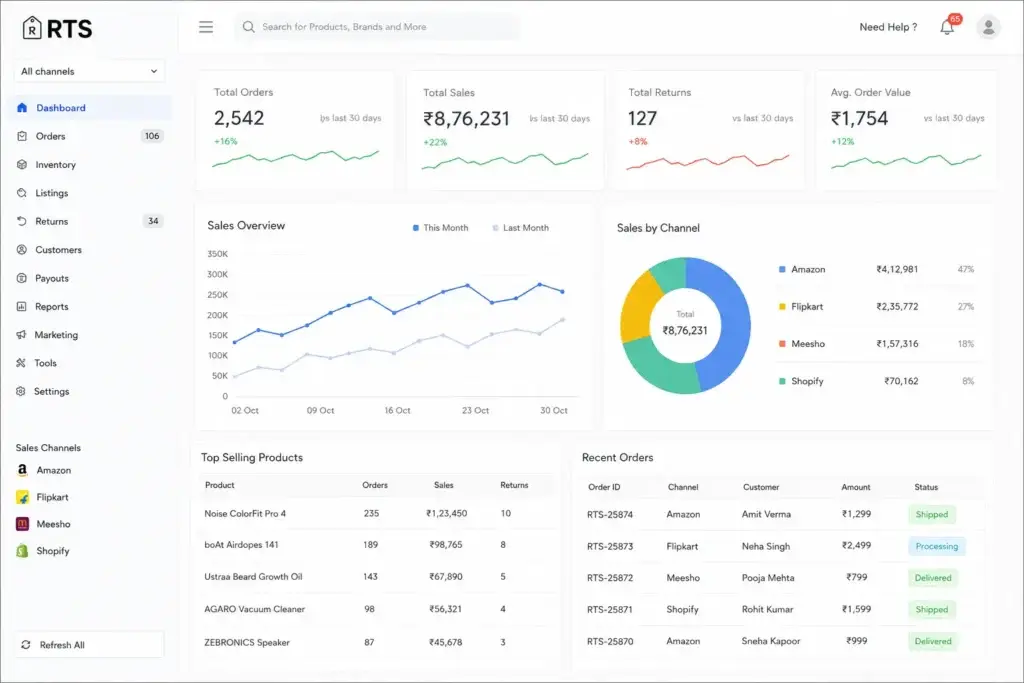
Every order — from every channel — funneled into one system, checked, packed, and dispatched on a schedule, with cancellations and returns processed the same day instead of piling up.
Inventory Sync
Real-time stock updates pushed across every marketplace and your own website at once. When a unit sells on Meesho, it’s automatically deducted everywhere else, so you never oversell or, worse, sit on “sold out” listings for stock you actually have.
Marketplace Management
This covers listing optimization, keyword and image updates, price monitoring against competitors, ad campaign management within Amazon/Flipkart’s own ad tools, and staying on top of each platform’s ever-changing seller policies — which is close to a full-time job by itself once you’re active on more than one channel.
Customer Support Outsourcing
A trained team handling pre-sale questions, order status queries, and returns/refunds with consistent tone and fast response times — protecting your ratings on every platform where response time is scored.
What Actual Growth Looks Like
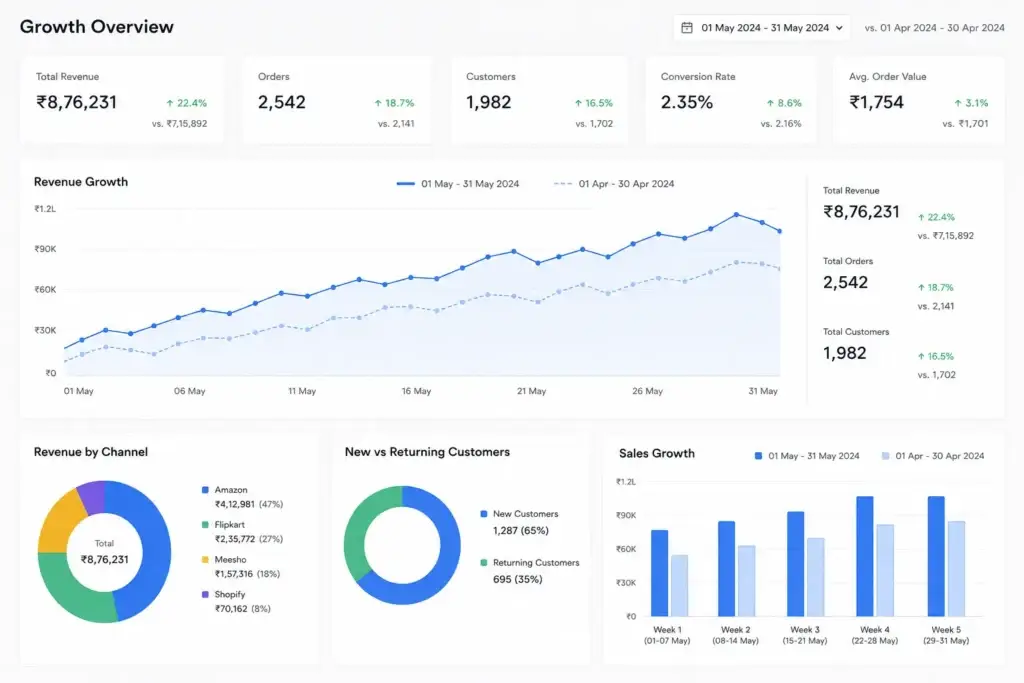
Growth from good ecommerce management rarely shows up as one dramatic spike. It looks like: fewer canceled orders because stock numbers are finally accurate, a support inbox that’s actually caught up, marketplace ratings recovering because complaints get resolved before they turn into negative reviews, and — because someone is finally watching the numbers — a clearer picture of which products and channels are worth doubling down on.
Do I need ecommerce management services if I'm only selling on one marketplace?
Even single-channel sellers benefit once order volume crosses a point where you can’t personally reply to every message within a few hours. The tipping point is usually less about revenue and more about your own time getting eaten up.
Can ecommerce management work alongside my existing in-house team?
Yes — most engagements slot in around an existing small team, taking over the repetitive operational load (order processing, basic support tickets, stock updates) while your team stays focused on sourcing, product decisions, and strategy.
What's the difference between hiring an ecommerce management consultant and a full-time ecommerce manager?
A full-time hire costs a fixed salary regardless of order volume and usually specializes in one area. A consultant brings a working system and covers multiple functions — order handling, listings, support — often at a lower and more flexible cost, especially while the business is still scaling.
How does inventory sync actually stop overselling across marketplaces?
Stock levels are updated in real time across every channel from one central system, so the moment a unit sells on any marketplace or your website, it’s deducted everywhere else automatically — no manual updating, no lag between platforms.
Will this help if my Amazon or Flipkart account health score has already dropped?
Faster, more consistent response times and quicker resolution of returns/refunds directly improve the metrics marketplaces use to score account health, so it can help recover a slipping score — though how much depends on what’s driving the drop.
What happens to customer queries during festive sales or high-order periods?
A dedicated support setup is built to absorb order spikes without response times slipping, which is usually when unmanaged stores fall furthest behind and rack up the most complaints.
Does marketplace management include running ads, or just listings?
It covers both — listing optimization (keywords, images, pricing) as well as managing ad campaigns within each platform’s own ad tools, plus keeping up with policy changes that affect how listings and ads perform.
My warehouse is in NCR — does courier delay during Delhi's winter fog season get handled too?
Order management includes tracking dispatch and delivery status across couriers, so delays get flagged and communicated to customers proactively instead of turning into cancellation requests or negative reviews.
How is profitability per SKU tracked once marketplace commissions and returns are factored in?
Order and inventory data across channels gets consolidated so you can see actual margins per product after commissions, shipping, and returns — rather than going by revenue numbers alone, which often hide loss-making SKUs.
How do I get started with a free ecommerce consultation?
Call or WhatsApp Ritwik Sachdeva at 9289626386, or visit ritwiksachdeva.in to book a free consultation and walk through where your store’s operations currently stand.
If your stock counts, support replies, or marketplace listings are quietly falling behind, it’s a good time to talk it through rather than let it pile up further.
Book a free ecommerce consultation with Ritwik Sachdeva — call or WhatsApp 9289626386, or visit ritwiksachdeva.in to get started.