
Why Branding Design Matters More Than a Logo for Delhi Businesses
Most Delhi business owners think branding is done once they’ve paid someone ₹5,000 for a logo on Fiverr. It isn’t. A logo is one asset inside a much bigger system — and if that system doesn’t exist, the logo ends up looking like a sticker slapped on a shop that has nothing else going for it. Real brand identity design covers how your business looks, sounds, and feels across every single touchpoint: your Instagram grid, your invoice, your packaging, your shop signage, your WhatsApp business profile picture, even the tone of your customer replies. Skip that system and your “branding” is just a PNG file sitting in a folder.
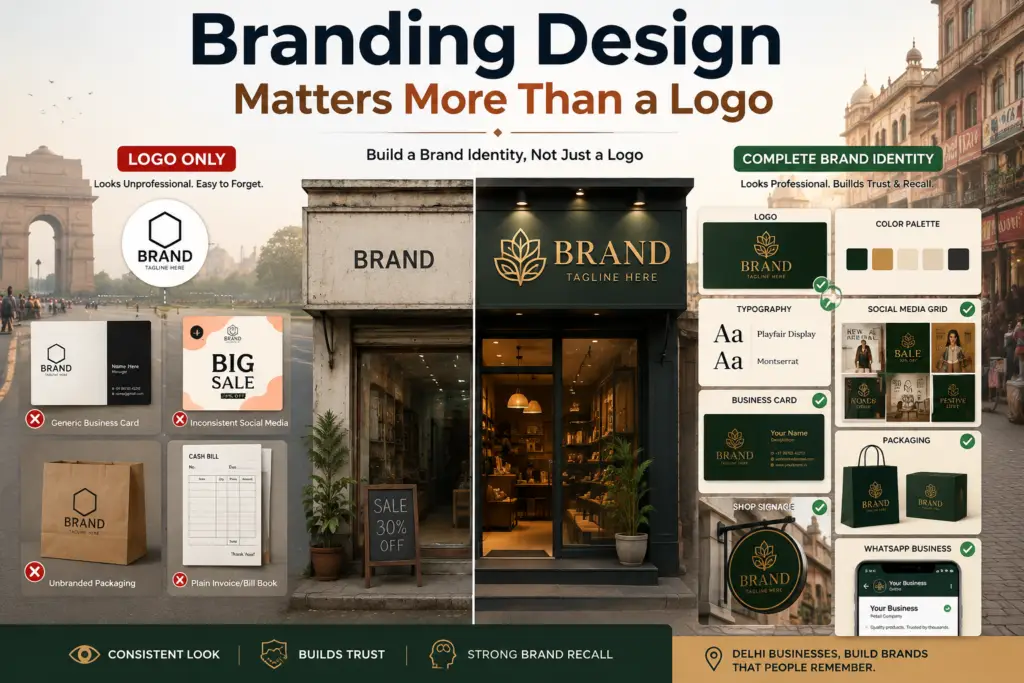
The logo-only trap
Walk through any Delhi market — Lajpat Nagar, Karol Bagh, Kamla Nagar — and you’ll spot the same pattern. A shiny new logo on the shutter, but the bill book is generic, the Instagram posts use five different fonts, and the packaging looks like it belongs to a completely different business. Customers pick up on this inconsistency even if they can’t name what’s wrong. It just reads as unprofessional, or worse, unreliable.
This is the core problem with treating a logo as the finish line. A logo is a mark. Branding is a decision-making framework — one that tells you what colours to use on a diwali sale banner, how formal your WhatsApp replies should sound, and what your packaging should communicate before a customer even opens the box.
What actual visual branding strategy includes
A logo is maybe 10% of the work. The other 90% is the visual branding strategy that makes the logo mean something:
- Colour palette and psychology — not “which colours look nice” but which colours signal trust, urgency, luxury, or affordability for your specific category. A jewellery brand and a quick-commerce grocery app should never share a palette logic.
- Typography system — a primary font for headings, a secondary one for body text, and rules for when each gets used. Random font-mixing across your website, packaging, and social posts is one of the fastest ways to look amateur.
- Brand voice — the actual words you use. Formal Hindi, casual Hinglish, English-only — this needs to be consistent whether it’s a customer support reply or an Instagram caption.
- Application system — how the identity translates to business cards, packaging, signage, social media templates, and your website. This is where most “branding” projects quietly fail, because the designer hands over a logo file and stops there.
Brand consistency is what actually drives recall
Here’s the part most business owners miss: people don’t remember logos, they remember patterns. Someone doesn’t recall “that circular blue icon” — they recall “that brand that always uses that specific shade of green and that clean, no-nonsense font.” That pattern recognition is brand recall, and it only builds through repetition across every single thing a customer sees.
If your Instagram grid looks different from your website, which looks different from your packaging, you’re resetting that recognition every single time instead of building it. A Delhi-based D2C brand competing with hundreds of similar accounts on Instagram genuinely cannot afford that reset. Consistency isn’t a nice-to-have design principle — it’s the mechanism by which a customer remembers you exist at all.
Why this matters more for Delhi businesses specifically
Delhi’s market is dense and hyper-competitive across almost every category — food, fashion, services, D2C, real estate. A generic logo with no system behind it gets lost instantly in a market where every second shop or Instagram page looks visually similar. What separates a brand that people actually remember from one that blends into the noise is exactly this consistency layer: the colours, type, voice, and application working together, everywhere, every time.
This is also where local context matters. A branding design consultant working in Delhi understands things a generic online logo service won’t — how a brand needs to read on a shop signage in Karol Bagh versus a D2C Instagram page targeting South Delhi, or how bilingual audiences (Hindi and English) need brand voice handled without it feeling forced in either direction.
Common questions Delhi businesses ask
Do I really need branding if I already have a logo?
Yes — a logo without a system behind it is just a graphic. Branding is what makes that graphic consistent and recognisable across every platform your business shows up on.
Isn't branding just for big companies?
No. Small businesses need it more, arguably, because they don’t have the marketing budget to make up for weak recall. A consistent, well-thought-out identity does a lot of the recognition work that a bigger ad spend would otherwise have to do.
How long does a proper brand identity project take?
It depends on the scope — a logo alone can take days, but a full identity system (colour, type, voice, application across packaging/social/signage) takes longer because each piece needs to be tested against real use cases, not just look good on a mockup.
Can I just update my logo and keep everything else the same?
You can, but it usually creates the exact inconsistency problem described above — a new logo sitting on top of an old, unrelated visual system looks more disjointed than doing nothing at all.
What's the actual difference between a logo and a brand identity?
A logo is a single mark — an icon or wordmark. Brand identity is the whole system around that mark: colour palette, typography, voice, and how all of it applies across packaging, social media, signage, and digital platforms. The logo is one output of that system, not the system itself.
My competitors all look similar on Instagram — how does branding help me stand out?
When every account in a category uses similar filters, fonts, and layouts, the businesses that stand out are the ones with a distinct, consistently applied colour and type system — not necessarily a wilder logo. Differentiation comes from consistency other accounts aren’t bothering with, not from being louder.
Does branding matter for a small shop that mostly gets walk-in customers, not online traffic?
Yes — signage, bill books, packaging, and even how staff greet customers all carry brand signals whether or not there’s an online presence. Walk-in-heavy businesses often have more physical touchpoints to get consistent, not fewer.
What happens if I skip branding and just focus on ads or offers?
Ads and offers can drive one-time visits, but without a recognisable, consistent identity behind them, customers often forget which business they bought from. Branding is what turns a one-time buyer into someone who recognises and returns to you specifically.
Should my brand voice be in Hindi, English, or Hinglish?
That depends entirely on the audience the business actually serves. A brand talking to a bilingual Delhi audience often needs a voice that moves naturally between Hindi and English without feeling forced in either — but the right call depends on the specific customer base, not a generic rule.
Can I design my own brand identity using free templates online?
You can start there, but generic templates are, by definition, not distinct — many other businesses are pulling from the same template libraries. The value in a custom identity system is that the colour, type, and application choices are made specifically for your business and audience, not picked from a shared pool.
Building a brand that Delhi actually remembers
If your business has a logo but no real system behind it, that’s the gap worth closing next — not another logo variant, but the framework that makes everything you put out look like it belongs to the same brand. For businesses looking at this as part of a wider identity overhaul, it connects directly to broader graphic design and branding design consulting work — the kind that treats the logo as one output of a system rather than the whole project.
If you’re a Delhi-based business ready to move past the logo-only stage, Ritwik Sachdeva works directly with local businesses to build that full identity system — colour, typography, voice, and application — rather than handing over a single file and calling it done. You can check past work and get in touch at ritwiksachdeva.in, or call directly at 9289626386 to talk through what your brand actually needs right now.