
Common Ecommerce Management Mistakes Delhi Brands Make
Most ecommerce management mistakes don’t show up as one big disaster — they show up as a slow leak. A few orders shipped late, a stockout on your best-seller during a sale, a support ticket that sat for two days. None of it looks fatal on its own. Add it up over a quarter and it’s the difference between a brand that scales and one that plateaus at the same revenue for two years straight.
Delhi’s ecommerce sellers deal with a specific mix of pressures: multi-platform listings (Amazon, Flipkart, Myntra, your own Shopify store), NCR traffic and warehouse logistics that don’t always cooperate, and festive-season demand spikes that can 3x overnight. That combination punishes weak operations faster than it would in a slower market. Here’s where most brands actually lose money — and what fixes it.
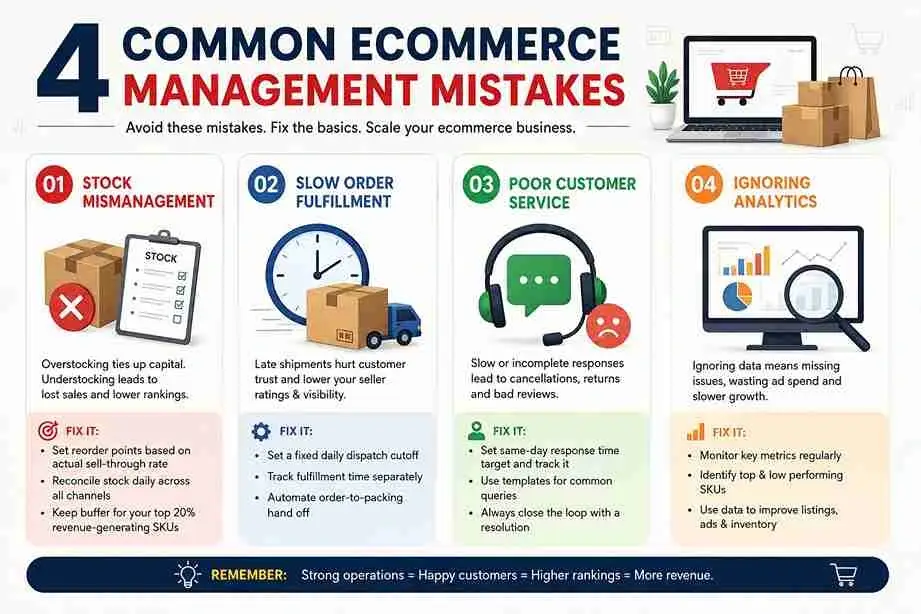
Stock Mismanagement
This is the single most common ecommerce operations issue, and it cuts both ways. Overstocking ties up working capital in inventory that sits in a warehouse costing rent instead of generating revenue. Understocking means you rank well, run a campaign, drive traffic — and then go “out of stock” right when demand peaks, which tanks your platform ranking algorithm’s confidence in you for weeks afterward.
The root cause is almost always the same: inventory decisions are made from gut feeling or last month’s numbers instead of a live view across every sales channel. A seller running the same SKU on Amazon, Flipkart, and their own website with no centralized stock tracking is flying blind — one channel oversells while another sits full.
What actually helps:
- Set reorder points based on your actual sell-through rate per SKU, not a flat “reorder at 50 units” rule that ignores which products move fast versus slow
- Reconcile stock across all marketplaces daily during sale periods, not weekly
- Keep a buffer specifically for your top 20% of SKUs — that’s usually where 70-80% of your revenue actually comes from, so those are the ones that can’t afford to go dark
Slow Order Fulfillment
Delhi and NCR have some of the best logistics infrastructure in the country, which makes slow fulfillment even harder to justify — and platforms notice. Amazon and Flipkart both weight seller rating and search visibility partly on fulfillment speed and order defect rate. A brand that’s consistently a day slower than competitors isn’t just losing a few impatient customers; it’s losing organic reach on the platform itself.
The mistake is usually structural, not effort-related. Orders pile up because packing and dispatch aren’t scheduled against courier pickup windows, or because there’s no clear owner for “orders placed after 6 PM” — so they default to the next day even when same-day dispatch was possible. Returns and exchanges often get deprioritized entirely, which quietly damages customer trust even when the original order shipped fine.
Fixing this usually comes down to process, not headcount:
- Build a fixed daily dispatch cutoff and staff around it, rather than treating pickup times as a moving target
- Track fulfillment time as its own metric, separate from “did the order eventually ship” — average days-to-dispatch tells you far more than a shipped/not-shipped count
- Automate order-to-packing handoff wherever your platform or tools allow it, so orders aren’t sitting in a queue someone has to remember to check
Poor Customer Service
Ecommerce customer service in India runs on a tighter clock than most sellers assume. A question left unanswered for six hours during business hours often means that customer has already ordered the same product from someone else, or filed a return request instead of asking a question first. Poor response time isn’t a soft metric — it converts directly into cancellations, negative reviews, and return rates.
The common trap is treating customer service as an afterthought that gets handled “whenever there’s time,” rather than as a defined function with response-time targets. Another version of the same mistake: answering the question but not closing the loop — a customer asks about a delayed order, gets a generic “we’re looking into it,” and never hears back with an actual resolution.
Specific, doable fixes:
- Set a real response-time target (same business day, not “soon”) and track how often it’s actually met
- Template your top 10-15 recurring questions so responses are fast and consistent, but always leave room to personalize the specific detail the customer asked about
- Close every complaint with a resolution message, even if the resolution is “refund processed” — silence after a complaint is what turns into a bad review, not the original problem
Ignoring Analytics
This is the quietest mistake on this list and often the most expensive. Every marketplace dashboard — Amazon Seller Central, Flipkart Seller Hub, your Shopify analytics — throws off data on conversion rate, return rate by SKU, traffic source, and drop-off points. Most sellers glance at revenue and units sold, and stop there.
That’s a problem because revenue tells you what happened, not why. A SKU with high returns is usually flagging a sizing issue, a listing that oversells the product, or a quality gap — but if nobody’s looking at return-rate-by-product specifically, that pattern stays invisible until it’s eaten into margins for months. Same with traffic sources: paid ads that look “fine” on total sales can actually have a worse ROI than organic once you separate the numbers out.
Where to actually start:
- Review return rate and reason codes by SKU monthly, not just total returns — the reason tells you what to fix
- Separate paid traffic performance from organic performance instead of looking at blended conversion rate
- Check search-term reports (on marketplaces that provide them) to catch keyword mismatches between what customers search and what your listing actually targets
Where These Mistakes Connect
None of these four problems exist in isolation. Poor analytics is often why stock mismanagement happens — if you’re not tracking sell-through by SKU, you can’t set accurate reorder points. Slow fulfillment often creates the customer service backlog, because delayed orders generate the support tickets in the first place. Fixing one in isolation gets you a partial win; fixing the operational system underneath all four is what actually moves the needle on repeat purchase rate and platform ranking together.
This is the kind of gap a dedicated ecommerce management service is built to close — not by adding more tools, but by putting a consistent process around inventory, fulfillment, support, and reporting so none of the four quietly slide.
How often should I audit my ecommerce operations for these issues?
A monthly review is the minimum during regular months. During festive or sale periods (Diwali, end-of-season sales), check stock levels and fulfillment turnaround daily — that’s when small gaps turn into stockouts or missed dispatch windows fastest.
Is stock mismanagement worse for multi-platform sellers?
Yes, significantly. A brand selling only on one channel can manage stock manually with reasonable accuracy. The moment you’re live on Amazon, Flipkart, and your own site simultaneously, manual tracking almost always leads to overselling on one platform or a phantom stockout on another, because inventory changes aren’t reflected everywhere at once.
What's a realistic customer service response time target for a growing D2C brand?
Same business day is a fair baseline for most Delhi-based sellers, with urgent order or delivery questions ideally answered within a couple of hours. It doesn’t need to be instant — it needs to be consistent enough that customers trust a reply is coming.
Do I need expensive software to fix these issues, or can process changes alone help?
Process changes alone fix a large share of this — a fixed dispatch cutoff, a weekly SKU-level stock reconciliation, and a response-time target cost nothing but discipline. Software helps once you’re managing enough SKUs or order volume that manual tracking itself becomes the bottleneck.
How do I know if my ecommerce operations actually need fixing, or if things are fine as they are?
Look at three numbers: stockout frequency on your top SKUs, average days-to-dispatch, and return rate trend over the last three months. If any of these is quietly getting worse month over month — even slowly — that’s the signal, not a single bad week during a sale.
Which mistake should I fix first if I can only tackle one right now?
Fix analytics visibility first, even though it feels like the least urgent one. Once you can actually see sell-through by SKU, return reasons, and traffic source performance, the other three problems become much easier to diagnose and prioritize correctly instead of guessing.
Does festive-season demand make these mistakes worse, or just more visible?
Both. The underlying gaps exist year-round, but festive spikes compress the timeline for reacting to them — a stockout that would’ve taken a week to notice in a normal month can cost you the entire sale window during Diwali or a flash sale.
Can poor customer service actually hurt my search ranking on Amazon or Flipkart?
Indirectly, yes. Both platforms weight seller performance metrics like order defect rate and negative feedback into how prominently your listings appear. Slow or unresolved customer service tends to show up as returns and complaints, which drags those metrics down over time.
Is it normal for a growing brand to have all four of these issues at once?
It’s common, not ideal. These four problems tend to arrive together because they share root causes — weak inventory visibility creates fulfillment delays, which creates support tickets, which go unresolved because there’s no dedicated process. Fixing them one at a time still helps, but tackling the operational system behind all four gets you further, faster.
How long does it typically take to see improvement after fixing these operational gaps?
Fulfillment speed and customer response time usually show improvement within a few weeks of process changes, since those are direct execution fixes. Stock accuracy and return-rate improvements take longer — often a full sales cycle or two — since they depend on better data building up over time.
Should I handle these fixes myself, hire in-house, or bring in an ecommerce management service?
It depends on your order volume and how many platforms you’re managing. A single-channel seller with low order volume can often fix these with better internal process alone. Once you’re managing multiple marketplaces with meaningful order volume, a dedicated ecommerce management service usually pays for itself by catching the gaps before they compound.
If your Delhi-based ecommerce brand is dealing with any of the issues above — stockouts, delayed fulfillment, slipping customer ratings, or simply not knowing where the numbers actually stand — Ritwik Sachdeva’s ecommerce management services can help you put a proper system around it. Reach out at 9289626386 or visit ritwiksachdeva.in to talk through where your operations currently stand.